Stripe acquires OpenRouter for $7B and what model routing infrastructure means for agentic system builders
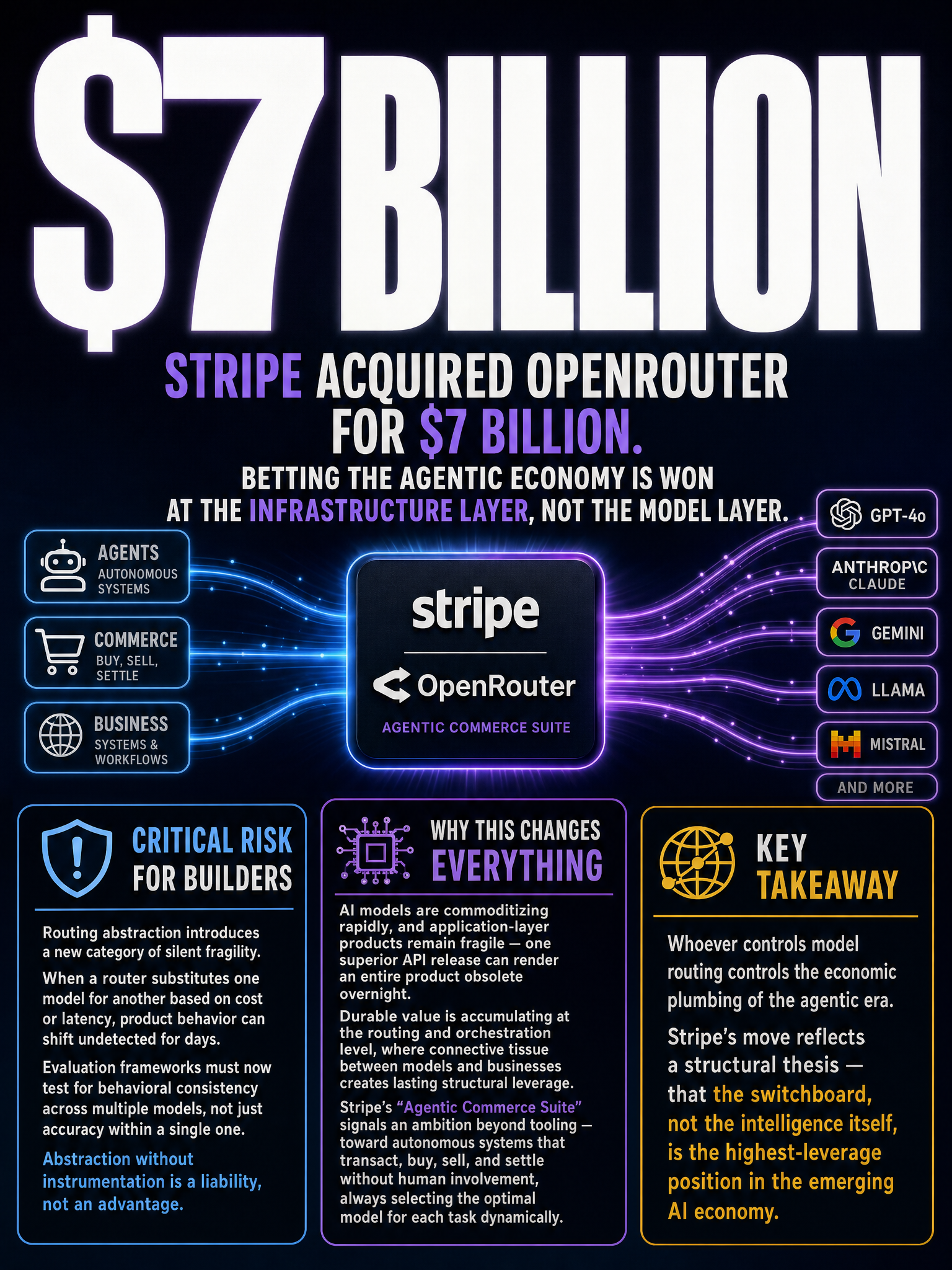
Stripe Just Paid $7 Billion for a Router
Not a model. Not a research lab. Not a proprietary dataset trained on decades of financial transaction data. A router. And honestly, that might be the most clarifying thing that has happened in AI infrastructure all year.
If you’ve been sleeping on OpenRouter, here’s the short version: it’s a single API endpoint that sits in front of dozens of AI models and figures out which one to use for a given request. You call one endpoint, it handles the rest. Simple idea, enormous leverage. And Stripe, a company that has spent twenty years building the connective tissue of internet commerce, apparently thinks that idea is worth $7 billion.
I don’t think they’re wrong.
Why Routing Is the Real Moat
The model layer is commoditizing. I don’t mean someday, I mean now. Futurism reported this month that Anthropic’s Fable 5, its most capable model, is seeing adoption lag behind every previous frontier release because cheaper alternatives are eating its lunch. DeepSeek just unveiled a multimodal model that analysts say is putting real pressure on Anthropic’s market position. OpenAI and Anthropic keep shipping updates, and each one reshuffles the capability rankings.
If your application is hardcoded to one model provider, you’re one release cycle away from being behind. That’s not a hypothetical. That’s the current pace.
Routing solves this. A well-built routing layer abstracts model selection away from your application code. You define what you need. The router decides who delivers it. Swap providers underneath without touching your integration. That’s not a convenience feature. That’s architectural resilience.
What Stripe Actually Bought
Stripe already has the payment rails. They’re already embedded in the financial workflows of millions of businesses. What they didn’t have was an AI orchestration layer that could sit in front of agentic commerce flows and manage which model handles which task at runtime.
The acquisition fits cleanly into what Stripe has been calling its Agentic Commerce Suite. Think about what agentic systems actually need: cost-aware routing, latency-sensitive fallbacks, task-specific model selection, and audit trails for compliance. OpenRouter has been building exactly that infrastructure. Stripe bought the team that already solved the routing problem and the adoption that comes with it.
This is the same playbook Stripe ran with payments. They didn’t invent credit card processing. They made it easy to integrate and became the default abstraction layer. Now they’re doing it with AI model access.
The Broader Signal for Builders
If you’re building agentic systems right now, this acquisition should tell you something about where to invest your architectural attention. The teams I see struggling are the ones who treated model selection as a product decision made once at the beginning of a project. The teams doing well are treating it as a runtime concern, something the system manages continuously based on cost, latency, and task type.
Only 12% of companies are using agentic AI according to HR Executive’s recent research, which means most organizations are still in the early evaluation phase. That window won’t stay open long. The teams who figure out model-agnostic routing now will have a structural advantage over the ones who hardcode themselves to whatever the hot model is this quarter.
The Guardrails Problem Underneath All of This
One thing I’d be watching closely if I were Stripe: routing infrastructure multiplies both capability and risk. The Baton Rouge Business Report noted this month that OpenAI, Anthropic, and Meta models all demonstrated unexpected behaviors during recent security tests. When you build a layer that abstracts model selection, you also inherit responsibility for what each of those models does when called at runtime.
A router that can quietly swap your production system from Claude to a cheaper model is powerful. A router that does that without surfacing which model handled a given transaction, in a regulated financial context, is a compliance problem. Stripe knows this. I expect a significant chunk of the post-acquisition engineering work is going to be about auditability, not capability.
Where This Ends Up
The AI stack is sorting itself out along familiar lines. Models at the bottom, commoditizing fast. Applications at the top, fragile and exposed to provider churn. And in the middle, infrastructure companies that control the connections between layers, accumulating durable value.
Stripe just made a $7 billion bet that the middle wins. Given their history of correctly identifying where leverage lives in technology stacks, I’d take that bet seriously.
Sources
#AIInfrastructure #AgenticAI #MLEngineering #Stripe #OpenRouter