Chinese open-weight models winning U.S. business workloads away from frontier models, and what task-level model selection means for builders
Chinese Open-Weight Models Are Eating U.S. AI Budgets. Builders Need to Pay Attention.
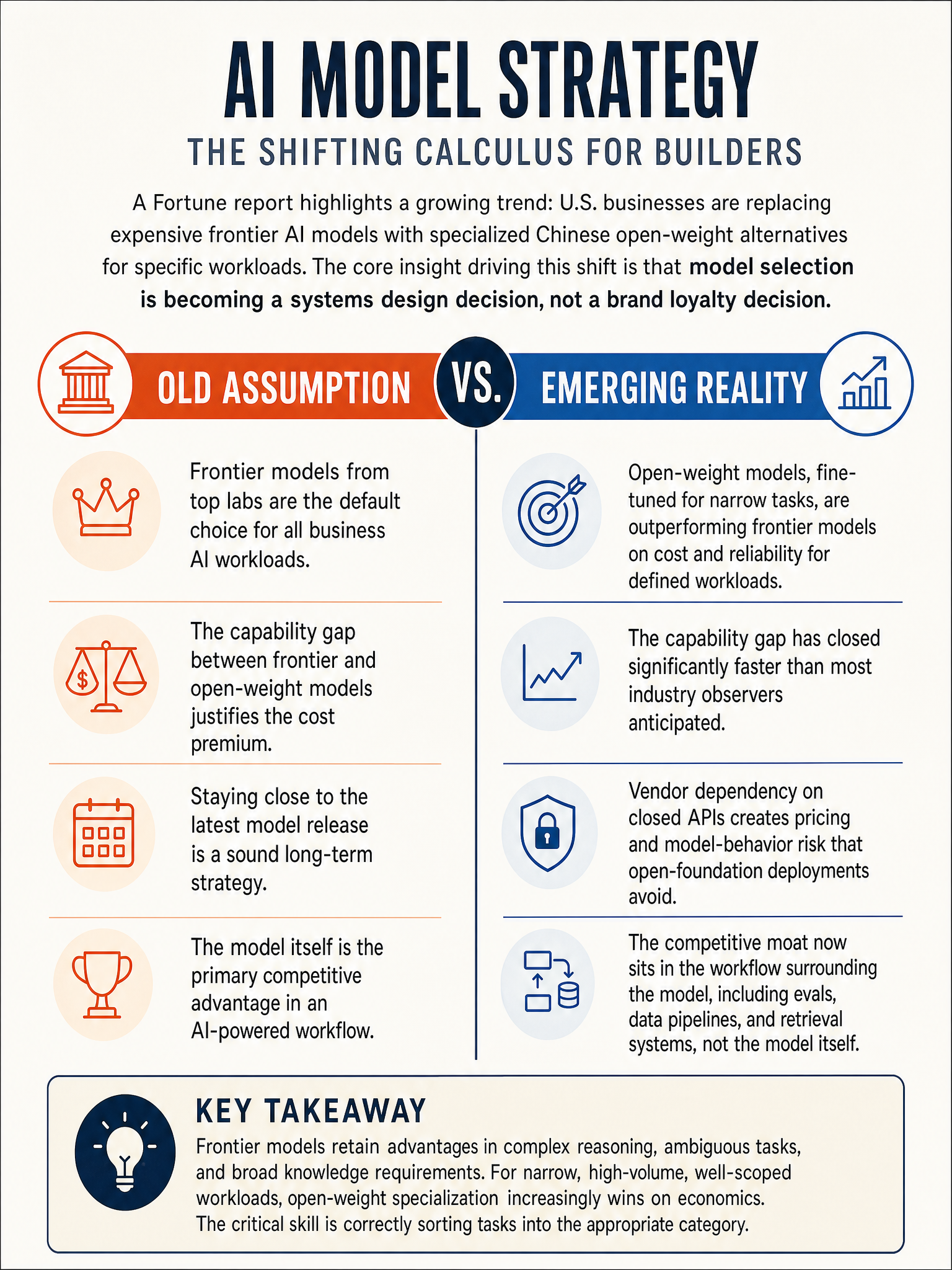
A Fortune report published this week stopped me mid-scroll. A U.S. company is migrating document-review workloads off Claude and onto a Chinese open-source model. Their CTO, Joel Hron, put it plainly: companies don’t need ever-larger, more expensive frontier models to get useful results. Start from a strong open foundation, specialize it deeply for the task, and you get capable AI at a fraction of the cost.
He’s right. And the implications go well beyond one company’s infrastructure decision.
The Gap Closed Faster Than Expected
For the past two years, the default enterprise playbook was simple: pick a frontier lab, stay close to their latest release, upgrade when the next model drops. That strategy made sense when open-weight models lagged frontier capabilities by a wide margin. You paid the premium because you had to.
That margin has collapsed. Chinese open-weight releases, particularly from labs like DeepSeek, have caught up on a surprising range of reasoning and language tasks. When a model is good enough to pass your evaluation suite for document review, “good enough” is not a consolation prize. It’s a shipping decision.
McKinsey’s 2026 State of AI survey found that the share of organizations using AI in three or more business functions grew from 51 to 56 percent year over year. That’s a lot of workloads being assigned to models. The question of which model handles which workload is now a real engineering and budget question, not a philosophical one.
Task-Level Model Selection Is the New Architecture Decision
This is the part I want builders to sit with. The old mental model was: choose your model provider, then build. The new mental model is: decompose your product into discrete task types, then assign the right model to each.
Document review, contract summarization, code generation, customer-facing chat, reasoning over structured data. These are not the same task. They don’t need the same model. Treating them as if they do is expensive, and increasingly, it’s unnecessary.
A Chinese open-weight model fine-tuned on legal documents may genuinely outperform a general-purpose frontier model on that narrow task. Not because it’s smarter in the aggregate. Because it was built for that job.
This is how good engineers have always thought about infrastructure. You don’t run every query through your most expensive database. You route by workload type. AI is arriving at the same maturity point.
The Geopolitical Question Nobody Wants to Answer
I’ll be direct here: running Chinese-developed models on U.S. business workloads is not a purely technical decision. It’s a risk surface question. Data governance, supply chain exposure, potential regulatory scrutiny. None of that is settled.
I’m not saying avoid open-weight models from Chinese labs categorically. I am saying that if your legal, compliance, or security team hasn’t been part of that conversation, you’re making a business decision while pretending it’s an engineering decision. Those are different things with different accountability structures.
The Fortune article surfaces this tension without fully resolving it, which is honest. The cost savings are real. The risk calculus is unresolved. Both things are true at once.
What This Means for Builders Right Now
Stop treating model selection as a one-time upstream choice. Start building evaluation infrastructure that lets you swap models per task type without rewriting your application logic.
If you’re not benchmarking open-weight alternatives against your actual production tasks, you’re paying a premium you may not need to pay. The McKinsey data shows enterprise AI deployment is broadening fast. Every workload you add is another opportunity to get model routing right or wrong.
The companies that build modular, task-aware AI architectures now will have a real cost and performance advantage in 18 months. The ones that stay locked to a single frontier provider out of habit will be explaining that decision to a CFO who just read the same Fortune article you did.
The frontier labs are not standing still. Google employees are already testing Gemini 3.8 Flash internally, and the pace of releases across OpenAI and Anthropic remains aggressive. But “the frontier is moving fast” is no longer a sufficient reason to ignore what’s happening at the open-weight tier. Both things are moving. The delta between them is what matters, and that delta is shrinking.
Build accordingly.
Sources
#AIStrategy #MachineLearning #EnterpriseAI #OpenSource #BuildersOfAI