Google DeepMind nearing Gemini 4 launch after nearly a year behind GPT-6 and Anthropic Mythos, and what it means for builders in production agentic systems
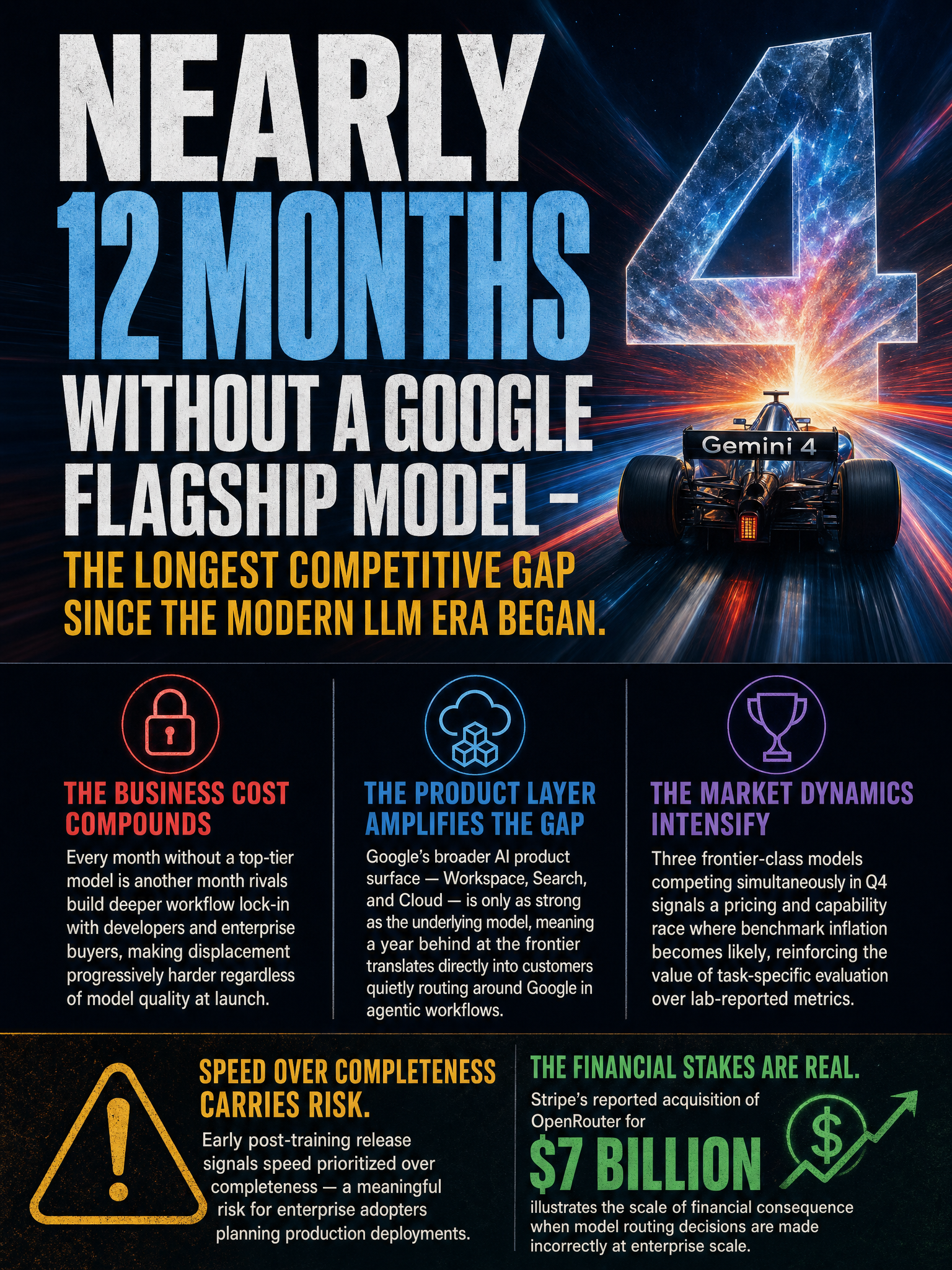
The AI frontier is moving fast enough that a year feels like a decade. Google DeepMind has been sitting on the sidelines watching OpenAI’s GPT-6 and Anthropic’s Mythos series pull ahead of Gemini 3, which launched back in November 2025. Now, according to reporting from The Verge, the new DeepMind chief Koray Kavukcuoglu is signaling that Gemini 4 is close. Not a full polished release. An early post-training version, pushed out as fast as they can get it done. The urgency in that framing tells you everything.
I think this is being underestimated.
The Gap Is Real and Getting Expensive
Ten months without a competitive flagship model is a long time when your rivals are shipping. Both GPT-6 and Anthropic’s Mythos series outperform Gemini 3 on the benchmarks that enterprise buyers actually care about, per The Verge’s reporting. Sundar Pichai acknowledged the gap publicly. That’s notable. CEOs don’t volunteer that kind of admission unless the competitive pressure is already visible internally.
The problem is not just technical. Every month Google spends without a top-tier model is another month of Anthropic and OpenAI building workflow integrations, securing developer trust, and getting embedded in enterprise procurement cycles. Switching costs accumulate quietly. By the time Gemini 4 ships, some of those relationships will already be locked in.
Meanwhile, Anthropic just dropped Claude Opus 5.5, which the company claims is 40% more efficient and 30% faster than its predecessor, with the focus squarely on agentic coding and computer use. This is less than two weeks after Dario Amodei publicly called for a slowdown in AI development. Make of that what you will.
🔧 What This Means for Agentic Systems
If you are building production agentic systems right now, model selection is not just a capability question. It is an infrastructure question.
The teams I know who went deep on Claude or GPT-6 integration over the last six months are not going to rip that out because Gemini 4 benchmarks well. They have tool-calling patterns, memory architectures, prompt scaffolding, and retry logic all tuned around specific model behaviors. That is real switching cost.
Google knows this. The “early post-training release” framing from The Information suggests they want to get Gemini 4 into developer hands before the architecture decisions for the next generation of agentic systems get made. That is the actual race. Not benchmarks. Developer adoption before lock-in hardens.
Google’s Real Advantage
Here is what I keep coming back to. Google has infrastructure that nobody else can match. Vertex AI, Google Cloud’s enterprise relationships, Search, Workspace, the entire Android ecosystem. What they have been missing is a model that makes enterprise buyers feel comfortable betting on Google over Anthropic. Gemini 3 did not clear that bar.
If Gemini 4 is genuinely competitive on coding, reasoning, and long-context tasks, Google can distribute it through channels that OpenAI and Anthropic cannot replicate. That is a structural advantage that only matters when the model is good enough to carry it.
The market is also crowded with noise right now. Nvidia just acquired Hugging Face for $13 billion. Mistral raised €3 billion. The European Commission is classifying ChatGPT as a very large online search engine under the Digital Services Act. There is a lot happening. But for builders making model decisions in production today, the Gemini 4 timeline is the one worth tracking closely.
🎯 The Bottom Line
Google does not need to win the benchmark war. They need to ship something credible before the window closes on the current generation of agentic system design. An early post-training release signals they understand that. Whether the model actually delivers is a different question, one we will not be able to answer until it ships.
What I will be watching is not the MMLU score. I will be watching how fast developer tooling and documentation lands, whether Vertex AI gets meaningful agentic workflow support at launch, and whether Google can get enterprise sales teams aligned to actually push this. The model is table stakes. The distribution is the game.
Sources
#AIEngineering #GenerativeAI #AgenticAI #GoogleDeepMind #Gemini4 #LLMs #MachineLearning #EnterpriseAI