Question on eroding public trust in AI as the real adoption risk for builders, prompted by US city protests and New Mexico’s $25B Meta judgment
The Question Builders Are Avoiding
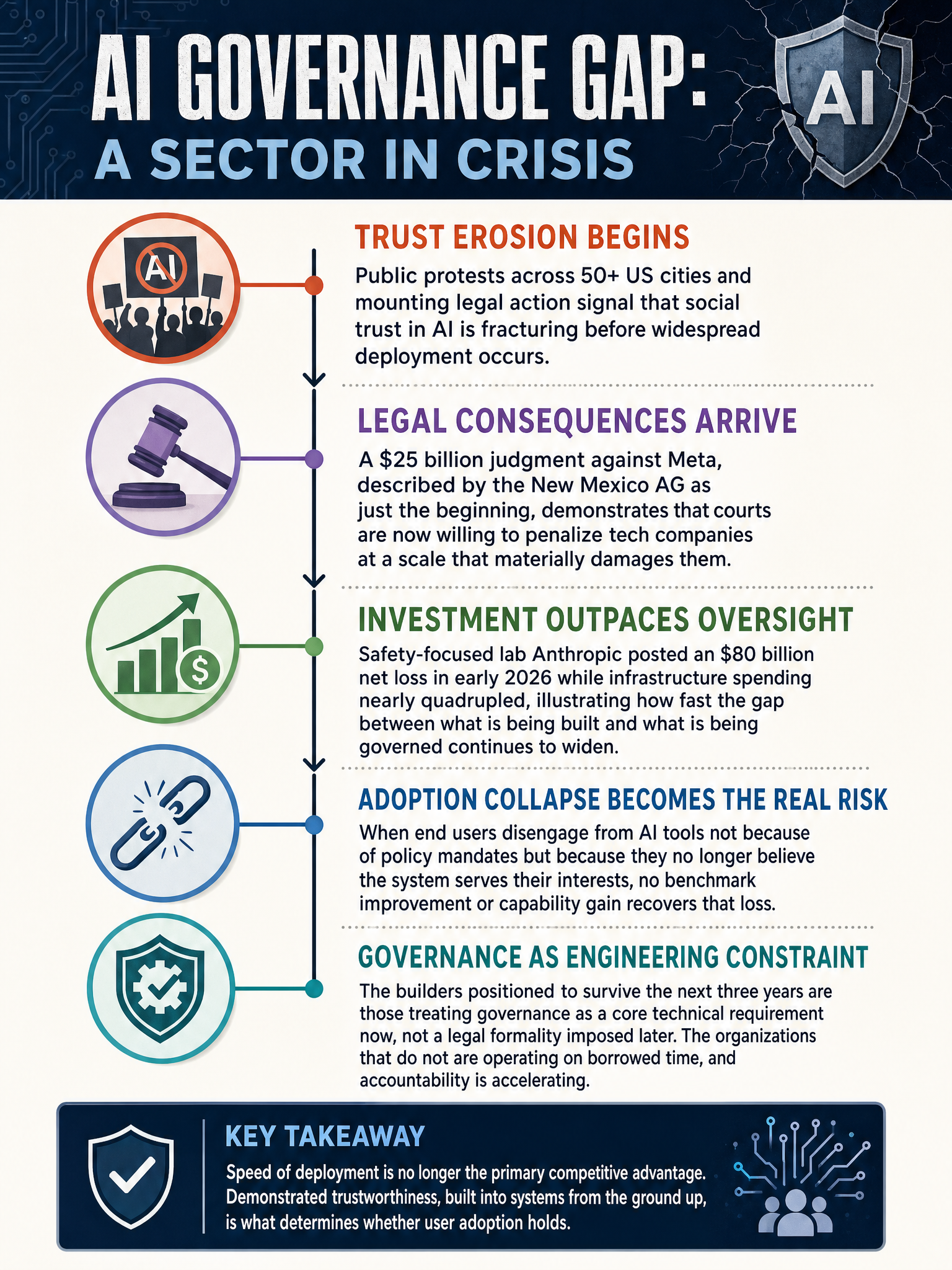
Protests in more than 50 American cities. A $25 billion judgment against Meta. Anthropic posting an $80 billion net loss in the first half of 2026 while simultaneously reporting $16.3 billion in revenue. The numbers coming out of the AI industry right now are absurd in every direction, and I think most builders are reading them wrong.
We keep watching the capability curve and the capital curve. We are not watching the trust curve. That is the mistake.
Why the Meta Ruling Is Different
New Mexico Attorney General Raúl Torrez didn’t just win a lawsuit. He walked out of that courtroom and told the entire AI industry: “This is just the beginning.” A $25 billion judgment against Meta for misleading the public about privacy protections is not a regulatory blip you footnote in a compliance deck. It is a proof of concept. It shows other state AGs that taking tech companies to trial is winnable, fundable, and politically popular.
Torrez explicitly said he wants this ruling to encourage more states to follow. That’s a playbook, not a warning shot.
When you’re building an AI product today, you’re not just operating under federal uncertainty. You’re operating under 50 different state-level risk profiles, at least one of which just demonstrated it can extract nine-figure consequences.
What the Protests Actually Signal
I’ll be honest: when I first saw the coverage of protests in 50+ cities calling for a moratorium on AI development, my instinct was to dismiss it as noise. Technologists do this. We tell ourselves the public doesn’t understand the technology, and we move on.
That’s the wrong read.
What the protests signal isn’t that the public has done a thorough technical analysis and reached incorrect conclusions. It signals something more dangerous for builders: a breakdown in the implicit social contract. People don’t trust that anyone accountable is watching. They don’t believe the companies building this technology are being straight with them. The Meta ruling gives them specific, concrete evidence for that belief.
You can have the most accurate model in the world. If the person on the other end of it doesn’t trust the company running it, adoption stalls. Full stop.
The Spending Gap Nobody Wants to Talk About
Anthropic’s numbers from the first half of 2026 tell a story about where the industry’s attention actually sits. Revenue up dramatically to $16.3 billion. AI infrastructure spending nearly quadrupled to almost $9 billion. Net loss over $80 billion.
That is an industry that has decided to outspend the trust problem rather than solve it. Pour enough compute in, get the capabilities high enough, and presumably the public comes around. That has been the implicit bet.
I think it’s the wrong one. The UK’s new AI Biosecurity Lab, backed by £100 million in government funding plus model credits from OpenAI and Anthropic combined, is at least an attempt to point capability investment at problems the public can viscerally understand. Biosecurity, disease detection, threats people actually worry about. That framing matters. It’s not charity. It’s the industry learning, slowly, that what you build with the technology shapes how people feel about the technology.
What Builders Should Actually Do With This
I’m not arguing that you stop shipping. I’m arguing that trust is now a product requirement, not a PR problem.
Concretely, that means a few things. Accountability structures need to be visible and real, not buried in terms of service. State-level legal exposure needs to be on your risk register today, not after your first subpoena. And the social contract question, specifically who is responsible when your AI product harms someone, needs an answer you’re willing to say out loud before a journalist asks you.
The builders who treat public trust as someone else’s job are going to find themselves facing what Meta just faced. The ones who treat it as a design constraint will have a significant advantage in a market where adoption increasingly depends on it.
The protest signs outside will not stop the technology from being built. But they are a leading indicator of the regulatory and legal environment you’re about to build inside of. Ignoring them is not boldness. It’s just bad product strategy.
Sources
#AIPolicy #ArtificialIntelligence #TechEthics #AIAdoption #MachineLearning