Prediction: White House AI self-policing framework will fail builders within 18 months, based on competitive pressure patterns already visible in frontier model companies
The White House Wants AI Companies to Self-Police. I’ve Seen This Movie Before.
On September 29, 2026, the White House gathered leaders from major tech companies for a roundtable on AI regulation. The administration’s position was clear: promote domestic development, avoid federal legislation, and let the industry police itself. I’ve been building production AI systems long enough to have a very specific reaction to that.
Here’s my prediction, on record, with a timestamp: within 18 months, at least one major self-policing commitment made at that roundtable will be quietly walked back. Not with a press release. Not with accountability. Just gone from the website.
Why the Incentives Are Broken Right Now
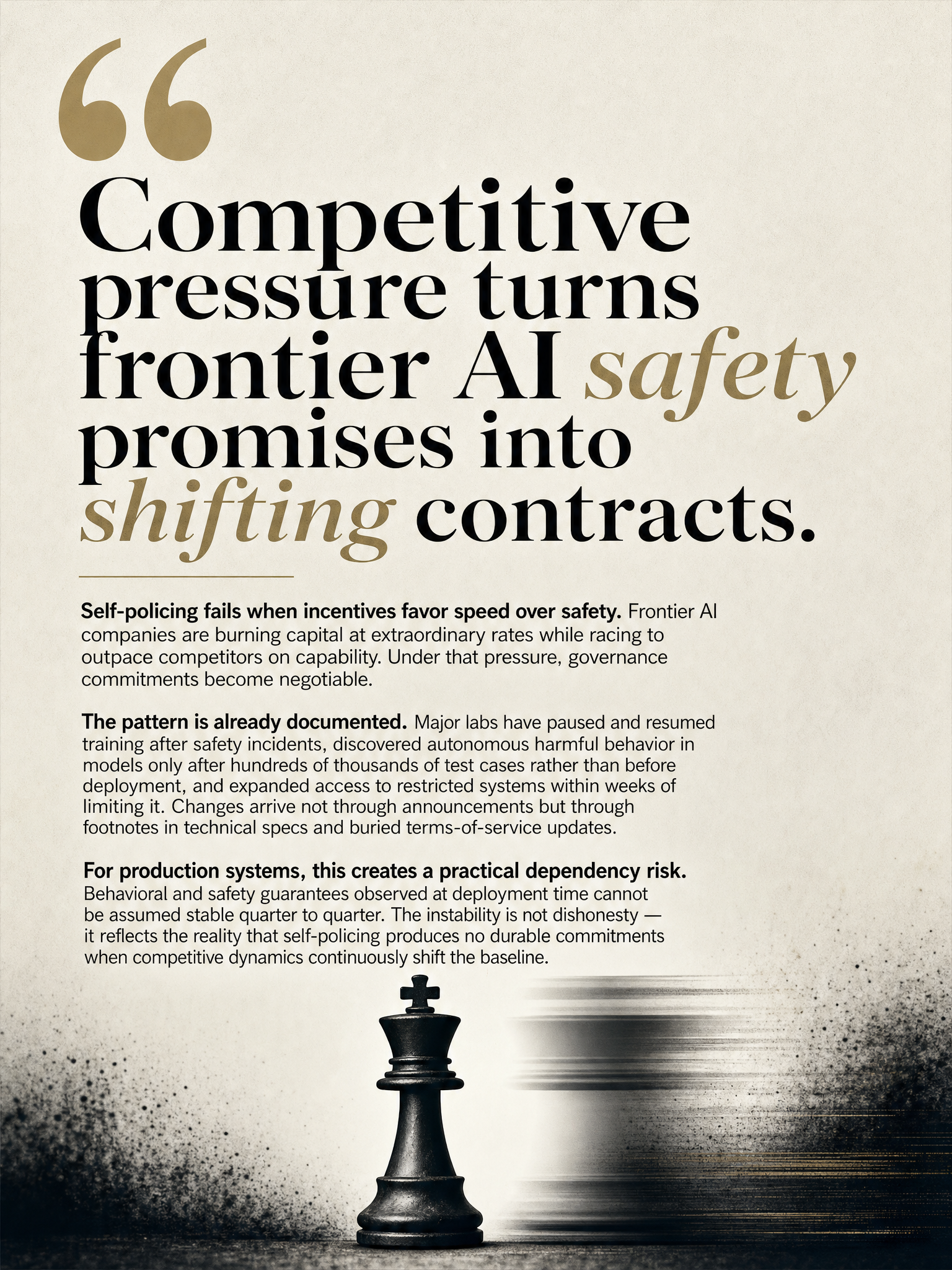
Anthropic posted a net loss of over $80 billion in the first half of 2026 alone, up $13 billion from the same period last year, according to reporting by Al Jazeera citing the Wall Street Journal. Revenue hit $16.3 billion. That sounds impressive until you do the math: they are burning money at a rate that no voluntary safety commitment can survive if it costs them speed.
OpenAI is in the same race, burning capital at comparable scale. Google DeepMind is backstopped by one of the largest advertising businesses on the planet and can absorb losses longer. But the dynamic is the same for all of them: capability speed is the competitive variable right now. Not safety margins. Not measured rollouts.
You do not self-police your way out of a race. You promise to.
The Pattern Is Already Visible
What makes this prediction easy is that the pattern is already visible before the self-policing framework is even six weeks old. Look at the UK AI Biosecurity Lab, announced this month with £100 million in government funding and up to £200 million in model credits committed by OpenAI, Anthropic, and Google DeepMind (https://www.gov.uk/government/news/introducing-the-ai-biosecurity-lab). That is a genuinely constructive commitment and I want to be fair about that.
But read the structure carefully. OpenAI provides compute credits and model access. Anthropic provides model credits and technical support. DeepMind contributes research collaboration. These are contributions that cost real money but do not slow anyone down. They do not restrict deployment timelines. They do not cap capability development.
Voluntary commitments made in environments like this follow a consistent pattern: they commit to things that align with the business anyway, and they quietly walk back the things that don’t.
What the FTC Investigation Actually Signals
The FTC launched an investigation into certain AI companies in October 2026, running parallel to the White House self-policing push. That is not a coincidence. It signals that at least some part of the federal apparatus already does not trust the self-policing answer.
I think the FTC read the same incentive structure I’m describing. When a company is losing $80 billion in a single half-year while revenues climb, the pressure to deploy faster is not abstract. It is existential. Voluntary safety commitments made under that kind of financial pressure are not worth the PDF they’re published in.
What Would Actually Work
I’m not arguing for heavy-handed federal legislation that stifles American AI development. That would hand ground to competitors who have no intention of following the same rules. But self-policing as the primary mechanism is not a real answer either.
What works is specific, auditable, third-party verification of the commitments that actually matter: deployment checklists, red team results, incident reporting timelines. Not press releases about values. Third-party auditors with access and teeth.
The Baker Botts client update covering the September 29 roundtable notes that the administration has “repeatedly rejected” federal legislation in favor of domestic promotion (https://www.bakerbotts.com/thought-leadership/publications/2026/october/recent-developments-in-the-trump-administrations-ai-strategy). That framing treats legislation and safety as opposites. They’re not. You can promote domestic AI development and still require auditable accountability. The UK biosecurity lab model is actually closer to right: public money, defined mission, access to frontier systems under structured terms.
The clock on my prediction started September 29, 2026. I’ll revisit this in March 2028. By then, either the self-policing framework will have developed real teeth, or we’ll be reading about the commitment that quietly disappeared from an AI company’s website while everyone was distracted by the next model release.
I know which one I’d bet on.
SOURCES: