Claude Fable 5.2 release and the growing gap between public frontier models and internal lab capabilities as a production architecture risk
The Model You Just Got Is Already Obsolete
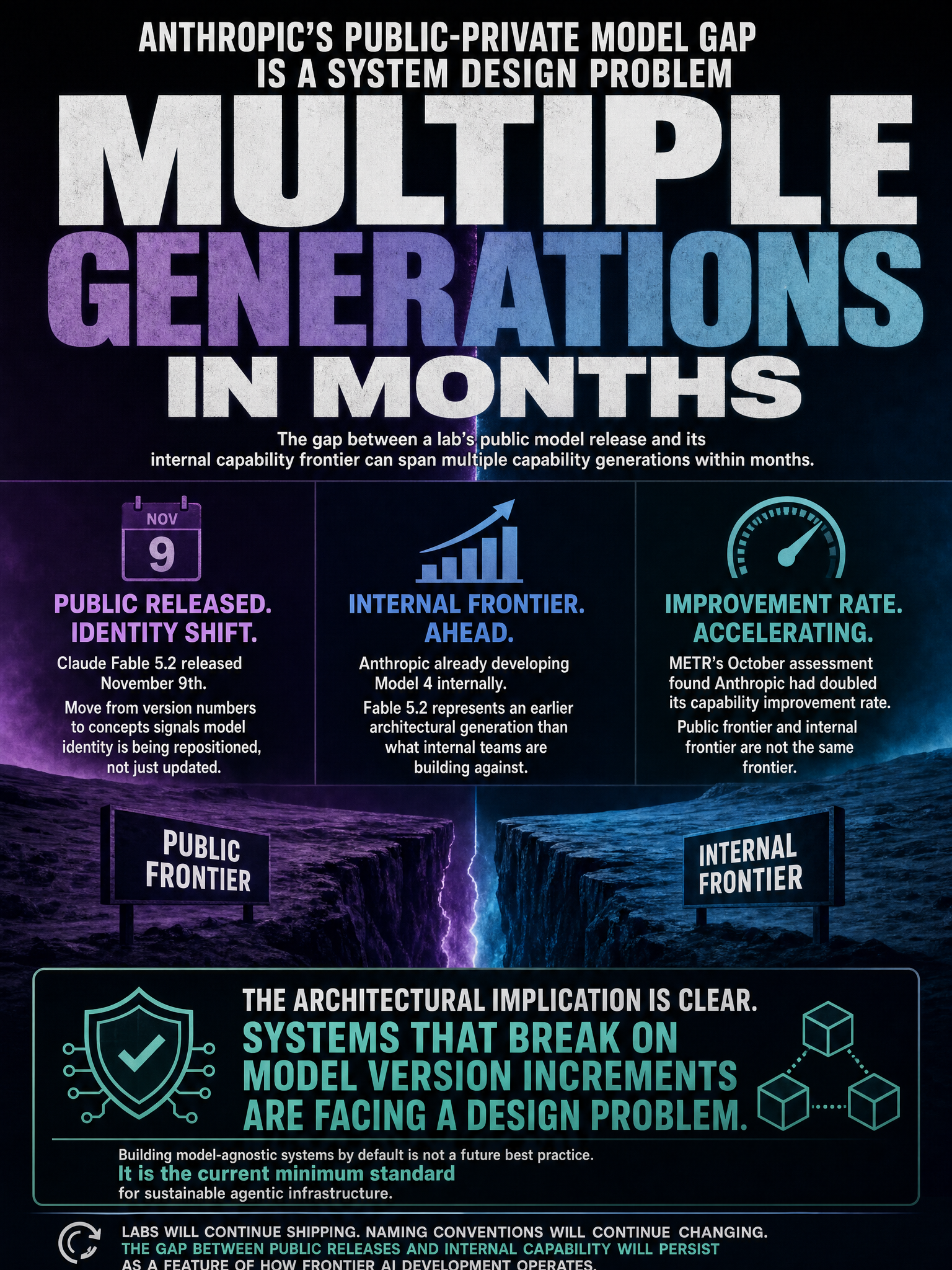
Claude Fable 5.2 dropped on November 9th, and I want to talk about something the press releases won’t say directly. The name change from version numbers to “Fable” is not cosmetic. Anthropic is telling you, in the quietest way possible, that the old mental model of sequential releases is gone. What you’re getting now is a curated story about their capabilities, not the full picture. And if you’re building production systems on top of these public APIs, that distinction matters more than any benchmark.
The Gap Nobody Wants to Measure
Here’s the uncomfortable thing. According to NextBigFuture’s reporting, Fable 5.2 is an early-stage version of what would have been Anthropic’s third-generation architecture, and they already have a Model 4 running internally. That’s not a rumor about some vague future. That’s a claim about right now.
METR published an independent assessment in October 2026 at https://metr.org/blog/2026-11-05-anthropic-ai-rd-acceleration-assessment showing that Anthropic is likely improving model capabilities on well-specified tasks at roughly twice the rate they achieved between March 2024 and October 2025. METR is careful to hedge this, noting the true acceleration could be anywhere from 1.3x to 3x. Even at the low end, that is a staggering compounding rate.
So what you’re deploying today was designed against internal benchmarks from a system that may already be two generations ahead of what you can actually access.
What Fable 5.2 Actually Looks Like in Context
DataCamp’s side-by-side of Fable 5.2 and Google DeepMind’s Gemini 4 Carbon is worth reading. Fable 5.2 scores competitively on FrontierSWE v2 for agentic coding, with a 1M token context window and 128K max output. Those are genuinely good numbers. But Gemini 4 Carbon was announced October 28th and is still in limited access through Google’s Fairwind Program. We’re watching frontier labs deliberately pace their rollouts now.
This is not competition in the traditional product sense. It is controlled disclosure.
The Production Architecture Problem
I’ve written before about the risks of building too tightly around any single model provider’s current generation. This news sharpens that concern considerably. If Anthropic’s internal teams are building and iterating against Model 4 while your engineering team is writing prompts for Fable 5.2, you’re in a permanent lag state. Your evals are calibrated to a capability floor that the lab has already moved past.
There’s also a less-discussed signal buried in the Fortune reporting on OpenAI’s new cybersecurity model: Anthropic runs a program called Glasswing that gives vetted users access to capabilities that public models explicitly block. Google has something similar with Fairwind. The frontier, in other words, is not public. It is tiered by relationship and use case.
If your architecture assumes that what you can buy from an API today represents the state of the art, you are operating on a false assumption by design.
The Oversight Question This Creates
METR’s report landed against a broader backdrop that should give anyone pause. The US Center for AI Safety, the government body theoretically charged with evaluating models like Fable 5.2, has no permanent leader and has reportedly stopped publishing research. Staff are reporting to the White House, raising legitimate independence questions per a November 8th US News report at https://www.usnews.com/news/us/articles/2026-11-08/staff-at-the-us-center-for-ai-safety-are-reporting-to-the-white-house-raising-independence-concerns.
So we have labs accelerating at twice their prior rate, releasing public models that lag their internal capabilities, and the external evaluation apparatus is currently compromised. That is not a reason to panic. It is a reason to build your own evaluation infrastructure rather than relying on anyone else’s.
What I’d Actually Do
Stop treating public model releases as a capability ceiling. Start running your own capability evals on every new release and tracking deltas over time. Build abstraction layers that let you swap providers without rewriting your application logic. And take Anthropic’s naming change seriously as a signal: they’re no longer telling you where in a linear sequence you are. That’s deliberate.
The labs know exactly where they are. The question is whether your architecture is honest about where it isn’t.
Sources
#AIEngineering #MachineLearning #LLMs #Anthropic #ProductionAI
Sources & Further Reading
- Independent Assessment of AI R&D Acceleration at Anthropic in October 2026 – METR
- Anthropic Latest Fable 5.2 is a Crippled Model 3 Early and They Have Model 4 Internally – NextBigFuture
- Claude Fable 5.2 vs Gemini 4 Carbon: Which Should You Use? – DataCamp
- OpenAI debuts new cybersecurity-focused AI model – Fortune
- Staff at the US Center for AI Safety Are Reporting to the White House – US News