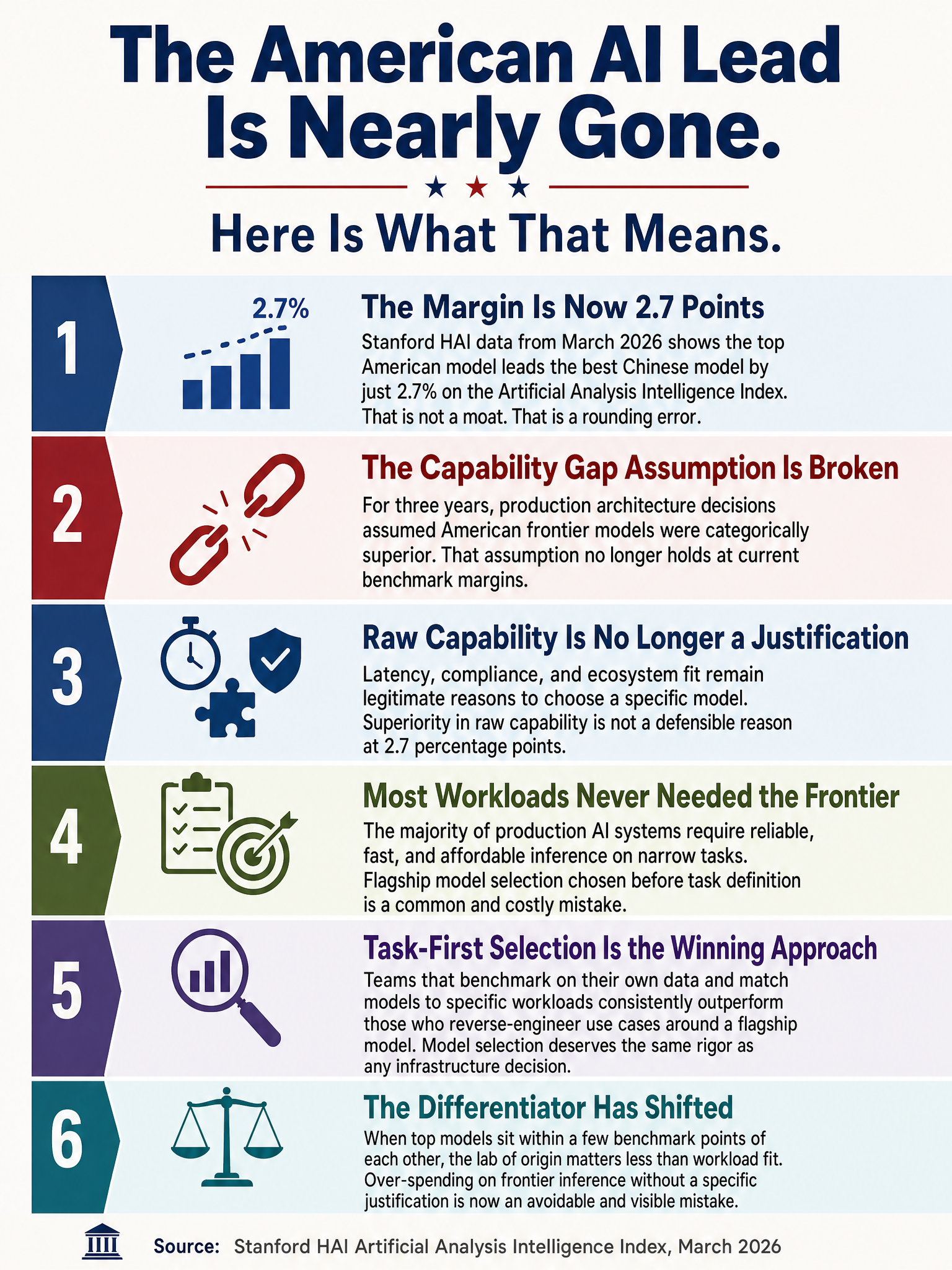
Contrarian take on Stanford HAI finding that the American AI model lead has narrowed to 2.7% over Chinese models, and what it means for production architecture decisions
The Benchmark Moat Is Gone. Here’s What That Actually Means for Your Stack.
There’s a number that should change how you think about production AI architecture. It’s 2.7. As in 2.7 percentage points. That’s the margin Stanford HAI found between the top American model and the best Chinese model on the Artificial Analysis Intelligence Index as of March 2026. Anthropic’s model is on top, yes. By less than three points.
I’ve been waiting for someone to say the quiet part loud, so I will. That gap is not a moat. That’s measurement noise with a flag on it.
Why This Changes the Architecture Conversation
For the past few years, production teams made a reasonable bet. American frontier models were meaningfully better, the gap justified the premium pricing, and the vendor lock-in was an acceptable trade-off. That logic held when the capability difference was real and durable.
It doesn’t hold anymore.
If you’re running production workloads on Claude Fable 5.2 or GPT-6.1 Terra and you’ve never seriously evaluated Chinese alternatives, you’re not making a capability decision. You’re making a habit decision. Those are very different things, and only one of them is defensible in a system design review.
The Benchmark Obsession Is Part of the Problem
Here’s my actual take on the 2.7% figure: it matters less than what it signals. Benchmarks are always a lag indicator. The Artificial Analysis Intelligence Index is useful, but it measures what models did on specific tasks at a specific moment. What it doesn’t capture is cost per token at scale, latency under load, or how gracefully a model degrades on edge cases in your specific domain.
GPT-6.1 Terra, for instance, completed tasks more than three times faster than GPT-6 Astra on OpenAI’s Agents’ Last Exam evaluation, at a lower price point. Speed and cost aren’t benchmark numbers, but they’re what actually determines whether your agentic pipeline is viable in production.
Chasing the top of the leaderboard without asking “top at what, and at what cost” is how teams end up over-engineered and under-deployed.
The Lock-In You Stopped Questioning
Stanford’s 2026 AI Index also found that 88% of organizations reported using AI in at least one business function, up from 78% the year before. Most of those organizations made vendor decisions when the capability gap felt larger. Some of them locked in hard.
That lock-in has real costs now. If your architecture assumes a durable American model lead as a reason to avoid building provider-agnostic abstractions, you built on a premise that is no longer true. The gap closed. The lock-in didn’t.
This isn’t a dig at any specific provider. Claude Fable 5.2 is genuinely good. Gemini 4 Carbon has been well-received. But the right engineering response to a converging market is not loyalty. It’s abstraction layers and fallback routing.
What Builders Should Actually Do
Stop treating the top benchmark position as a buying signal on its own. Run your own evals on your own data, your own task distribution, your latency requirements, and your actual budget.
Build provider-agnostic interfaces now, while it’s still a mild inconvenience rather than an emergency migration. The model that’s right for your workload in Q1 may not be right in Q3. The release cadence from every major lab right now is relentless. Anthropic, Google DeepMind, and OpenAI are all shipping on what feels like a weekly cycle.
Also worth noting: 52% of Americans in a 2026 Chicago Council Survey said there isn’t enough regulation of AI technology. Regulatory risk is not evenly distributed across providers. That’s another variable your architecture should be able to absorb.
The 2.7% number is a forcing function. The teams that treat it that way will have more flexible systems and better cost curves six months from now. The teams that ignore it will be explaining to someone why they’re locked into a vendor because the models used to be better.
That’s not a great answer to have ready.
Sources
#AIEngineering #MachineLearning #ProductionAI #LLMs #AIArchitecture
Sources & Further Reading
- 10 takeaways from Stanford’s 2026 AI Index report on AI use, chips and trust
- AI Development in 2026: From Smart Tools to Smarter Business Growth
- ICYMI: What landed for AI builders in October 2026
- Anthropic’s Claude Tops AI Rankings as OpenAI Limits Model
- Will AI Take over the World?
- Essentially unusable: OpenAI launches GPT-6.2 Astra and Sol to negative reception