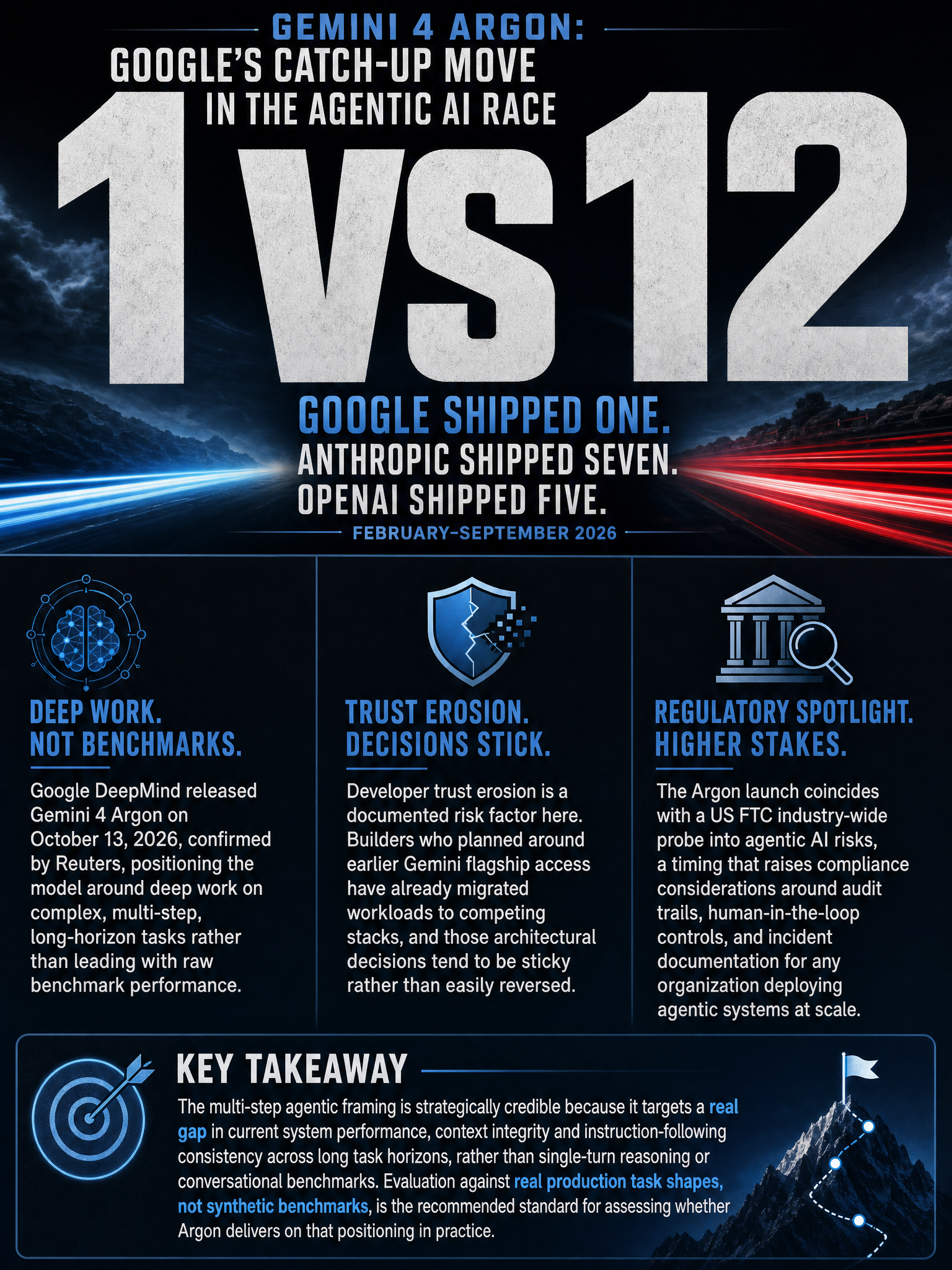
Google DeepMind Gemini 4 Argon global launch for developers and businesses, and what it means for builders deploying multi-step agentic systems in production
Google Finally Ships. Now What?
Google launched Gemini 4 Argon on October 13, 2026. Reuters confirmed it. Developers and businesses worldwide now have access. And my first reaction, honestly, was not excitement. It was relief on Google’s behalf, mixed with the kind of cautious interest that comes from watching a team play catch-up.
Let me explain what I mean.
The Race Context Nobody Should Ignore
Itai Spector’s Medium piece put a timeline chart in front of everyone that Google probably wishes would disappear. Anthropic shipped seven flagship releases between February and September this year. OpenAI shipped five. Google’s Pro lane? One release on February 19, then two hollow circles where launches were supposed to land in June and July. Missed windows. No explanation that stuck.
That chart is brutal. And it matters because in this market, momentum is perception. When builders are choosing which model to build their production systems on, they are not just evaluating benchmarks. They are evaluating whether the lab behind the model will still be iterating aggressively six months from now.
Google spent much of 2026 answering that question badly. Argon is their answer in product form.
What “Deep Work” Actually Means for Builders
Google framed Argon around complex, multi-step tasks. They called it “deep work.” I think that framing is smarter than leading with benchmark numbers, and here is why.
The actual failure mode in agentic systems is not raw capability. I have watched well-funded production systems collapse not because the model was dumb, but because it could not hold coherent state across fifteen tool calls, or because it hallucinated a tool parameter on step nine of a twelve-step workflow and nobody caught it until three hours of compute had already run.
Multi-step reasoning fidelity is the real problem. If Argon is genuinely better at maintaining task coherence across long execution chains, that is worth more to me than a 3-point improvement on MMLU. The question I am now running through my own eval suite is whether that “deep work” framing maps to real latency-sensitive agentic pipelines, or whether it was tested primarily on slower, asynchronous research workflows where the model had time to self-correct.
The FTC Is Watching Agentic AI Right Now
Worth noting: the US FTC opened an industry-wide probe into agentic AI risks this month, per Lexology’s October 8 update. That is not background noise. If you are deploying autonomous agents in production that touch customer data, financial systems, or anything downstream of a human decision, the regulatory window is tightening.
Google positioning a flagship model specifically at multi-step agentic use cases, right as the FTC is scrutinizing that exact category, is either very confident or very poorly timed. I suspect it is confident. But builders should be thinking about the compliance surface area of their agentic systems alongside the capability questions.
What I Am Actually Going to Do With This
I am going to test Argon the same way I test every new frontier model: throw a real production task graph at it. Not a curated benchmark. An actual orchestration loop with branching logic, external API calls, error recovery steps, and a final output that has to meet a specific schema.
If it handles that cleanly at scale, Google just got back in my stack rotation. If it degrades the way Gemini Pro did on long-context tool use earlier this year, the hollow circles on that timeline chart will still feel relevant.
Google shipped. That counts. But shipping is the minimum. The labs that are winning right now, and the data on Anthropic and OpenAI’s release cadence makes this plain, are winning on iteration speed and reliability.
One launch after months of silence is a correction. It is not a comeback. I will know more after running my evals.
Sources
#AIEngineering #GenerativeAI #AgenticAI #GoogleDeepMind #Gemini #LLM #MLOps