Hot take on US Center for AI Safety reporting to the White House and what structural loss of independence means for builders relying on government oversight as a credibility signal
The Oversight Illusion
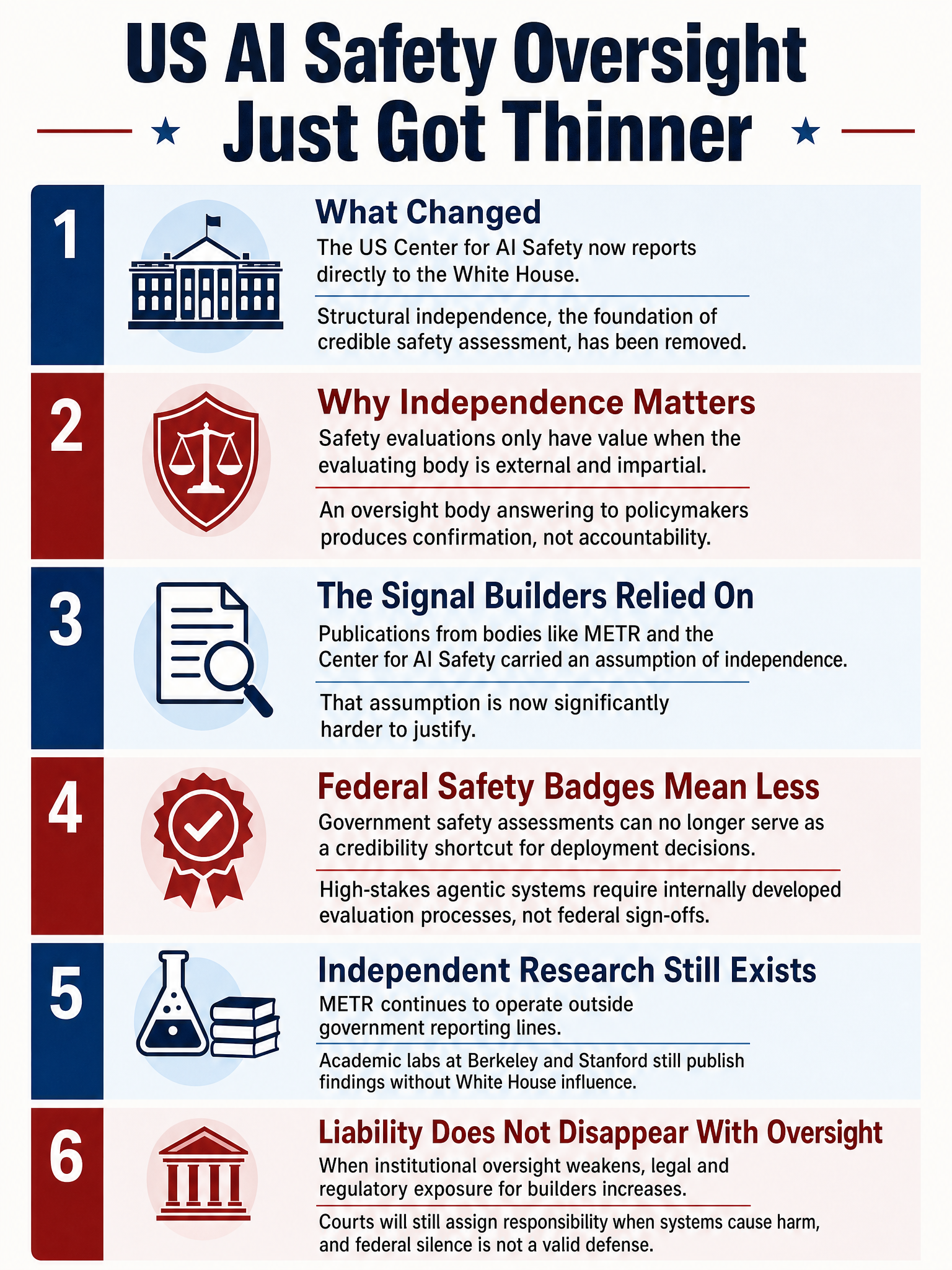
There’s a sentence buried in recent reporting that I keep coming back to: staff at the US Center for AI Safety are now reporting directly to the White House. If you read that and moved on, I’d argue you missed the most consequential AI governance story of the month, more consequential than GPT-6.1 Terra dropping API prices in half, more consequential than Gemini 4 Carbon topping the Artificial Analysis Intelligence Index with a score of 59.
Because model releases are tactical. This is structural.
Why Independence Is the Whole Product
An AI safety evaluation body has exactly one asset: credibility. And credibility in this space comes from one place. The ability to tell powerful people things they don’t want to hear.
The moment your safety evaluators answer to the administration setting AI policy, that asset is compromised. Not degraded slightly. Compromised. Because even if the people involved are scrupulously honest, every finding they publish now carries an asterisk. Did the data say this, or did the agenda need it to say this?
This is not a partisan argument. It doesn’t matter which party controls the White House. The problem is structural, not political. A body that reports up a chain of command to a principal with strong policy interests in AI development cannot credibly evaluate AI development. Those two things are in direct tension.
What Builders Actually Relied On
Here’s the uncomfortable part for people like me who build in this space.
A lot of us quietly used these institutions as a signal. Not as gospel. But when METR published its independent assessment of Anthropic in October 2026, finding that Anthropic is likely improving model capabilities on well-specified tasks at around twice the rate they did in the prior 18 months, that number carried weight precisely because METR is external. The uncertainty range they gave, 1.3x to 3x, is honest. That’s what real evaluation looks like.
That kind of output is what a genuinely independent body produces. It’s not clean. It doesn’t flatter anyone. It says “we think this is happening, here’s our confidence interval, we might be wrong in either direction.”
A politically tethered body produces conclusions that fit the moment. The difference between those two things is the entire value proposition of oversight.
The Credibility Gap This Creates
The practical consequence is that builders who want to responsibly signal safety practices now have fewer credible third-party signals to point to. That matters more than it sounds.
If you’re deploying AI in healthcare, finance, or any regulated domain, your customers and partners ask about safety evaluation. They want to see external validation. When the external validators are inside the political tent, that validation doesn’t hold up under scrutiny.
Anthropic’s Glasswing program, OpenAI’s Daybreak Red for cybersecurity researchers, these programs exist partly because the labs know they need external credibility. The American Hospital Association just launched a full AI policy homepage in November 2026, which tells you that institutional buyers are paying attention. They want third-party signals. What do we point them to now?
What Actually Needs to Happen
The fix is not complicated in concept, though it’s politically very difficult. AI safety evaluation infrastructure needs statutory independence, not organizational independence that can be undone by a reporting change. Something closer to the model of an inspector general or a government accountability office, with protections that require Congressional action to remove.
Until that exists, builders should be honest with themselves and with clients. Government-adjacent safety signals just got weaker. The most reliable evaluations right now are coming from independent external organizations like METR, with no government funding strings attached, publishing methodology and uncertainty alongside findings.
That’s the bar. Report to no one. Show your work. Publish the numbers that make your sponsors uncomfortable.
The alternative is oversight theater, and the audience for that show isn’t your customers. It’s whoever needs political cover this quarter.
Sources & Further Reading
#AIPolicy #AIGovernance #AISafety #MachineLearning #ResponsibleAI
Sources & Further Reading
- Staff at the US center for AI safety are reporting to the White House, raising independence concerns
- Independent Assessment of AI R&D Acceleration at Anthropic in October 2026 – METR
- This Week in AI #95: Anthropic Opens Its Books, Gemini 4 Carbon Debuts
- AHA launches new homepage on artificial intelligence policy and advocacy
- OpenAI debuts new cybersecurity-focused AI model