Insight on the AI validation bottleneck: generation capacity now far outpaces real-world testing throughput in research workflows
The Validation Bottleneck Nobody Is Funding
There is a quiet crisis in AI-assisted research, and most of the people building the tools that caused it are not talking about it.
Google DeepMind published an essay this week that caught my attention. The subject is AI agents reshaping scientific discovery, from hypothesis generation to experiment design. Their conclusion is worth sitting with: the hardest part is no longer coming up with ideas. It is testing them in the real world. They called it the validation bottleneck, and they outlined four priorities for policymakers and researchers to address it.
I think they are underselling how broken this actually is.
The Asymmetry Problem
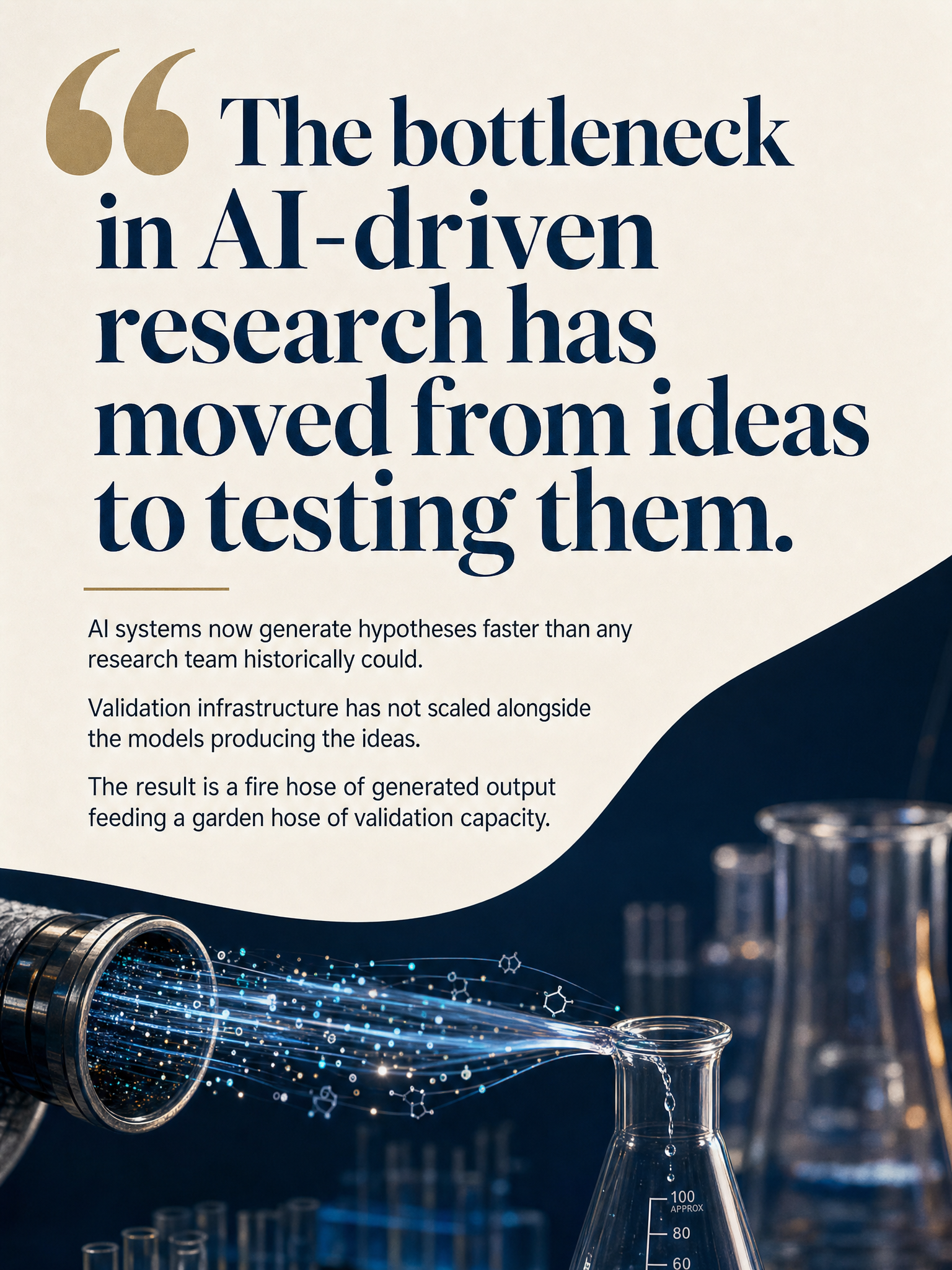
Here is what I keep running into when I talk to research teams. A capable AI system can generate 50 plausible hypotheses in roughly the time it used to take a team to generate 3. That sounds like pure upside. More ideas, faster iteration, better science. But your wet lab did not scale with the model. Your clinical trial pipeline did not scale. Your A/B testing infrastructure, your regulatory review process, your IRB approval queue, none of those moved.
So you have a fire hose of ideas feeding a garden hose of real-world testing capacity. The bottleneck did not disappear. It got worse, and it moved downstream.
This is an infrastructure problem wearing the costume of a capability problem.
Why This Gets Ignored
Funding follows the flashy stuff. New model architectures, new benchmark records, new agent frameworks. The validation layer is boring by comparison. Nobody is getting on stage at a conference to announce they cut clinical trial cycle time by 18%.
But that is exactly where the compounding gain lives. If you can generate ideas 15x faster and test them at the same rate you always could, you have not accelerated science. You have accelerated frustration. You have built a queue.
The DeepMind essay gestures at this, and Sam Altman amplified their thinking this week, calling the proposal from Demis Hassabis “thoughtful.” That alignment between the two labs on a structural research problem is itself worth noticing. This is not a competitive flashpoint. It is a shared constraint.
The Real Cost
Consider what happens to a drug discovery pipeline when hypothesis generation suddenly outpaces wet lab throughput. You do not get faster drugs. You get a prioritization problem. Someone has to decide which 3 of the 50 ideas get a shot at real-world testing. That decision is now the bottleneck, and it is being made with the same heuristics and institutional politics that existed before the AI showed up.
The model did not fix that. It made the cost of a bad prioritization decision higher, because now you are picking from a larger, less curated pool.
What Needs to Change
The DeepMind essay outlines four areas for policymakers. I will not speculate on their exact language, but the shape of the answer is clear: we need investment in the physical and regulatory infrastructure that validates ideas, the same energy going into inference speed and model capability needs to flow into experiment throughput and approval pipelines.
That means funding faster lab automation. It means rethinking regulatory review cadences for AI-generated research outputs. It means building better triage tooling so that prioritization of ideas is itself informed by AI, not just idea generation.
The loop is broken at the testing stage. Fixing the generation stage more does not help.
Closing Thought
The teams that figure out how to compress the validation cycle, not just the ideation cycle, are the ones that will actually move science forward. The model is the easy part now. The hard part is building the world that can keep up with it.
That gap will not close on its own.
Sources & Further Reading
#AIResearch #MachineLearning #ScientificDiscovery #AIPolicy #ResearchInfrastructure