Jensen Huang breaks from Trump trade delegation to eat noodles in Beijing hutong, reflecting NVIDIA’s complex position in US-China AI chip tensions
Jensen Huang Ate Noodles in a Hutong. That Tells You Everything.
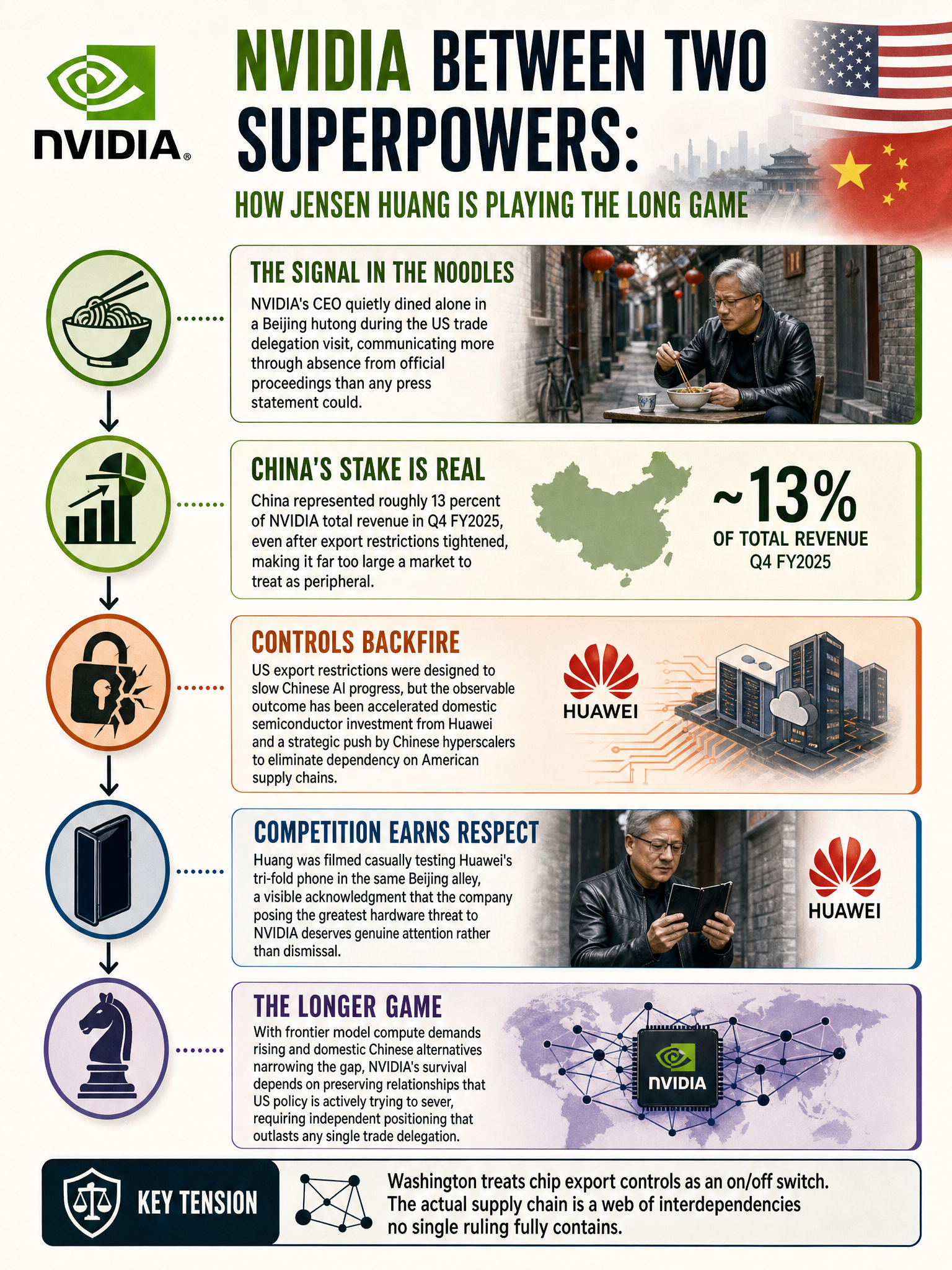
There’s a moment from the Trump trade delegation visit to Beijing in May 2026 that I keep coming back to. While diplomats and executives performed the usual theater of geopolitical trade talks, Jensen Huang, the CEO of the company that makes the chips powering virtually every serious AI system on the planet, slipped away from the official schedule and walked into a Beijing hutong to eat zhajiangmian at a local noodle shop called Fangzhuan workshop.
That’s it. That’s the whole thing. And it says more about the state of US-China AI competition than most of the policy papers I’ve read this year.
The Man in the Middle
NVIDIA sits in an impossible position right now, and Jensen isn’t pretending otherwise. He showed up in Beijing as part of a US trade delegation, the American flag in the room. Then he walked off to eat local food in a traditional alley neighborhood, got filmed playing with a Huawei tri-fold phone, and smiled the whole time.
Some people will read that as naivety or bad optics. I read it as someone who understands exactly where the physics of this market points, regardless of what Washington wants to legislate.
The H20 Situation Is the Real Story
Here’s what the policy conversation keeps glossing over. The US restricted NVIDIA’s top-tier chips from going to China. So NVIDIA designed the H20 specifically to comply with those restrictions. It has lower interconnect bandwidth than the H100 or H200, specifically tuned to fall under the regulatory threshold. And those chips are still moving into China at serious volume.
Meanwhile, Huawei is building its Ascend stack from the ground up. Chinese labs like DeepSeek have demonstrated that with the right software optimization, you can do a lot with hardware that the US considers second-tier. DeepSeek R1 ran competitively against Western frontier models and was trained at a fraction of the reported cost of comparable US efforts. The assumption that export controls create a clean hardware ceiling is getting tested in real time.
Jensen knows the Chinese AI market is not going away. It’s not a rounding error. China is a massive revenue source for NVIDIA, and the customers there are building real systems.
What Export Controls Actually Do
I’m not arguing controls are pointless. Cutting off access to the H100 and H200 genuinely matters for the most compute-hungry frontier training runs. There’s a real gap between what you can do with an H20 cluster and what you can do with an H100 cluster at scale. That gap exists.
But export controls are a ceiling, not a wall. They slow things down. They force adaptation. They don’t freeze the competition in place while the US sprints ahead unchallenged. The people writing these policies sometimes talk as if China’s AI progress is purely a function of Nvidia GPU access, and that’s just not accurate anymore, if it ever was.
The software layer matters enormously. Talent matters. Data matters. Huawei’s Ascend 910B is not a paper product. It’s running production workloads.
Why the Noodle Bowl is the Right Frame
What Jensen did in that hutong wasn’t accidental. CEOs with his profile don’t stumble into photo ops. He went into a neighborhood that Beijing residents actually live in, ordered something real, and let himself be seen enjoying it. That’s a message to Chinese customers, to Chinese regulators, and honestly to Washington: NVIDIA is not treating China as a market to be abandoned.
The geopolitical pressure to pick a side is enormous. The financial pressure to stay commercially relevant in China is equally enormous. Jensen is trying to thread that needle, and frankly, I think he’s right to try. A purely decoupled world where NVIDIA exits China entirely helps Huawei more than it helps America.
There’s no clean answer here. The noodle shop visit doesn’t resolve the tension. Nothing does right now. But I’d rather have the CEO of America’s most important AI hardware company eating zhajiangmian and keeping relationships alive than writing off a billion-person market out of political convenience.
The hard version of this conversation isn’t about optics. It’s about whether American hardware and software can stay relevant enough to matter when the next generation of Ascend chips ships, and the one after that.
That’s the race. The delegation is just the backdrop.
Sources
#NVIDIA #AIPolicy #JensenHuang #AIChips #USChinaTech #MachineLearning #ArtificialIntelligence