NotebookLM major upgrade: agentic chat capabilities, advanced reasoning, and new output formats
NotebookLM Just Got Agentic. Pay Attention.
Google dropped a meaningful update to NotebookLM this week and the AI discourse barely flinched. Everyone was busy watching Anthropic’s policy announcements and xAI’s plugin marketplace rollout. Fair enough, those are real stories. But I think the NotebookLM upgrade deserves a harder look, because it changes what the tool actually is.
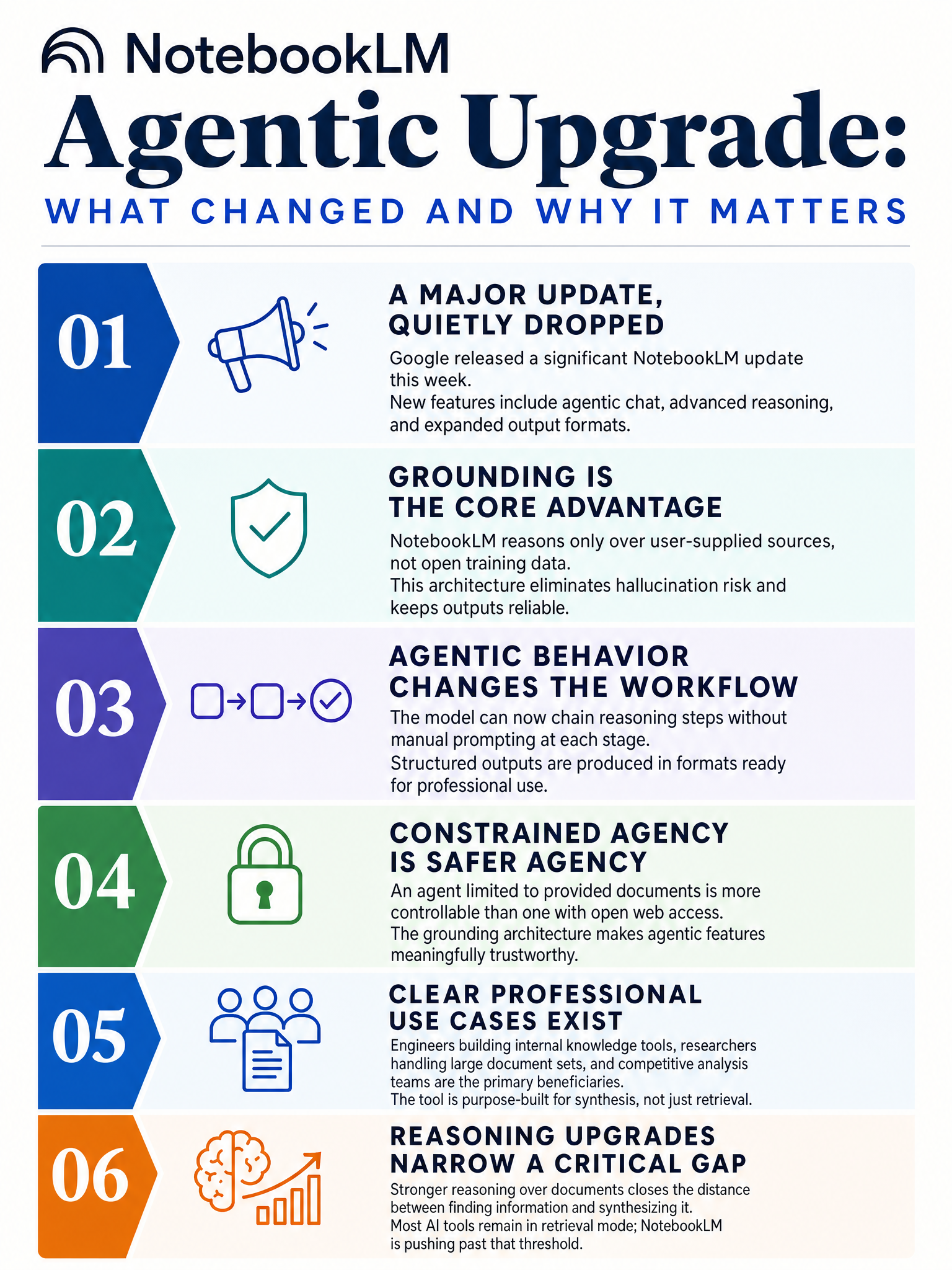
The short version from Google AI’s own post: NotebookLM now has agentic capabilities in chat, more advanced reasoning, and a suite of new output formats. That’s the whole announcement. Three lines. Let me tell you why the first item on that list is the one that matters.
What Made NotebookLM Different to Begin With
Before you can appreciate the upgrade, you have to understand what NotebookLM was already doing right. The core design is source-grounded reasoning. You give it documents, PDFs, transcripts, research papers, whatever. It reasons over those sources and only those sources. It does not reach into its training data to fill gaps. That constraint made it unusually trustworthy in a field where hallucination is the default failure mode.
Most people treated that constraint as a limitation. I always thought it was the whole point. You are not asking a model to remember things. You are asking it to think clearly about a fixed body of material you trust.
That foundation did not change. The upgrade builds on top of it.
What Agentic Chat Actually Changes
Agentic behavior in this context means the model can chain reasoning steps without you manually prompting it forward at each stage. In a standard chat loop, you ask, it answers, you ask again. You are the orchestrator. You decide when to go deeper, when to pivot, when to synthesize.
Agentic chat shifts some of that coordination to the model. It can determine when a question warrants deeper exploration of your sources, pursue that exploration across multiple internal steps, and return with a structured result rather than a surface-level response. You ask a complex question about a 200-page corpus. Instead of getting a paragraph that skims the top, you get something that actually traversed the material.
Combined with more advanced reasoning, this is a real capability jump. Not a UI refresh. The new output formats extend this further. If the model can now produce structured deliverables from your sources (reports, summaries, outlines formatted for a specific purpose), then NotebookLM stops being a research assistant and starts being closer to a research collaborator.
Why Source-Grounding Plus Agency Is a Strong Combination
Most agentic systems have a trust problem. When an agent is browsing the web, calling APIs, or drawing from broad training data, you often cannot verify where a conclusion came from. The chain of reasoning is opaque and the sources are diffuse.
NotebookLM’s agentic upgrade operates inside a closed information environment that you defined. The agent cannot go rogue and hallucinate a statistic from somewhere else. It is still bounded by your corpus. That is an unusual design choice and I think it is the correct one for knowledge work.
The failure mode for most AI tools in enterprise and research settings is not that they are too slow or too limited. It is that they are confidently wrong in ways that are hard to catch. Bounded agentic reasoning is one of the more sensible approaches I have seen to that problem.
Where This Fits in the Broader Moment
Google also launched Gemini 3.5 Live Translate this week, a live speech-to-speech translation model, alongside Project Genie. Google DeepMind announced a $10 million research fund with Schmidt Sciences and others to study emergent collective behaviors when millions of AI agents interact. That last one is worth a separate post entirely.
The industry is moving fast on agentic systems right now. OpenAI is scaling Codex access. xAI just opened a plugin marketplace for Grok Build with Vercel, MongoDB, and Sentry integrations. Everyone is building toward agents that do more with less human hand-holding.
NotebookLM’s approach is narrower than most of those bets, and that is precisely what makes it credible. Narrow, grounded, and now more capable is a better product trajectory than broad, ambitious, and unreliable.
What I Am Watching Next
The new output formats are underspecified in the announcement. I want to know what structured formats are actually available, whether they can be customized for specific workflows, and how well the reasoning traces hold up under scrutiny when the source material is ambiguous or contradictory. That last test is where most models fall apart.
If Google has genuinely tightened the reasoning layer while keeping the grounding intact, NotebookLM moves from a tool I recommend to researchers and analysts into something I would build workflows around. That is a different category.
Try it on a real corpus before you form an opinion. A handful of tweets and a short document is not the test. Throw a few hundred pages at it and ask something that actually requires synthesis across the whole thing.
That is the only benchmark that matters here.
Sources
#NotebookLM #GoogleAI #AITools #AgenticAI #MachineLearning #ProductivityAI #GenAI