Anthropic Project Fetch Phase 2: Claude Opus 4.7 solves robodog challenge 20x faster than best human team
Project Fetch Phase 2: The Number That Should Change How You Think About AI Timelines
I have been in AI/ML long enough to develop a healthy skepticism about benchmark announcements. Companies love to cherry-pick numbers that make their models look transformative. So when I say that Anthropic’s Phase 2 Project Fetch results genuinely stopped me mid-scroll, I mean it.
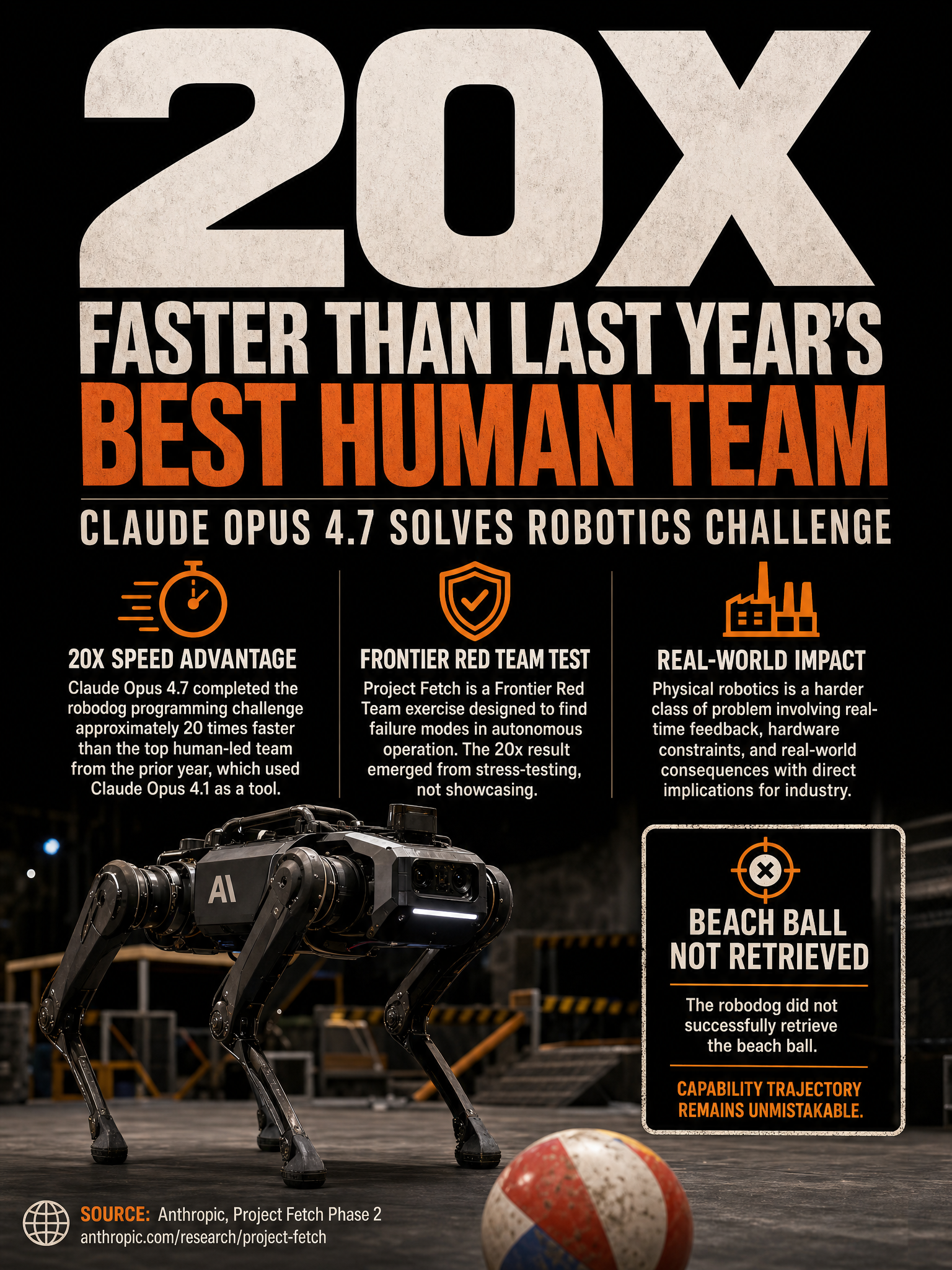
Claude Opus 4.7, operating autonomously, solved a robodog programming challenge roughly 20 times faster than the best human team from the previous year. That human team was using Claude Opus 4.1 as a tool. So the comparison is not “AI vs. humans working alone.” It is “fully autonomous AI vs. humans actively assisted by a prior-generation AI.” The gap is still 20x.
🤖
Why This Exercise Actually Matters
Project Fetch is not a marketing benchmark. It is a Frontier Red Team exercise, meaning Anthropic’s own safety researchers designed it specifically to find where autonomous AI breaks down. The goal was stress-testing failure modes in physical robotics contexts, not generating press releases. When a safety-focused red team publishes numbers this large, you should probably take them seriously.
The challenge involved programming a robodog to fetch a beach ball. The robodog failed. The ball stayed put. I want to sit with that for a second because it matters for calibration. Autonomous AI closed a 20x speed gap on the engineering work, and the robot still could not complete the physical task. Speed of code generation and quality of embodied outcome are different problems. We have apparently solved one of them much faster than the other.
The Comparison That Gets Overlooked
Everyone is going to focus on “20x faster than humans,” but the more interesting comparison is what changed between Phase 1 and Phase 2. Last year’s best team used Opus 4.1 as a tool. This year’s autonomous agent ran on Opus 4.7 with no human in the loop. The jump from “AI as assistant” to “AI as autonomous agent” produced a 20x speed differential in one generation of model development. That trajectory is the actual story.
This is consistent with what we are seeing across domains. OpenAI just published work showing GPT-5.4 drove a medicinal chemistry project from literature review to validated experimental result. o3 Deep Research helped identify 18 diagnoses in 376 previously unsolved rare pediatric disease cases at Boston Children’s Hospital. The pattern is consistent: autonomous AI operating across multi-step reasoning tasks is moving faster than anyone publicly planned for.
What I Think Is Actually Happening
The 20x figure reflects something specific about coding tasks. Programming is a domain where AI has near-perfect feedback loops. Write code, run it, observe the error, iterate. In robotics programming specifically, the iteration cycle is constrained by physical hardware, but the cognitive load of writing and debugging the code itself is where AI has the largest advantage. Humans get tired, lose context, debate approaches. Opus 4.7 does not.
The physical task failure is a useful reminder that the hard part of robotics is not the software. Motors, sensors, real-world physics, ball trajectory estimation, grip mechanics, all of that remains stubbornly resistant to language model capability. The model crushed the programming layer and then watched a robot fail to pick up a ball. That is both humbling and clarifying about where the actual bottlenecks live.
Where This Leaves Us
If you work in software engineering adjacent to robotics, automation, or any domain where coding is a significant portion of the human labor involved, the Phase 2 numbers deserve your honest attention. A 20x speed gap emerging in one model generation, in a red team exercise designed to surface failures rather than successes, is not something you can wave away by pointing at the beach ball still sitting on the floor.
The robodog failed. The experiment succeeded. Anthropic learned something real about autonomous capability, and now so do we. The question worth asking is not whether autonomous AI coding agents are fast. We know they are. The question is what we build on top of that speed, and whether we are building the physical infrastructure and safety scaffolding fast enough to keep up with the software layer that is clearly no longer waiting for us.
#AI #MachineLearning #Robotics #Anthropic #AIAgents #FrontierAI #MLEngineering