OpenAI launches GPT-5.5-Cyber, Codex Security, and Patch the Planet as a coordinated cybersecurity platform
OpenAI Just Turned Security Upside Down
The standard move in AI security announcements is to drop a model, publish some benchmark numbers, and call it a day. OpenAI did something different this week, and I think most of the coverage is missing the actual story.
Yes, GPT-5.5-Cyber is impressive. State-of-the-art on CyberGym, designed specifically for authorized defensive work: tracing vulnerable code, validating issues, developing patches, preparing evidence for human review. That part is real and matters.
But the benchmark isn’t the news. The system around it is.
What They Actually Built
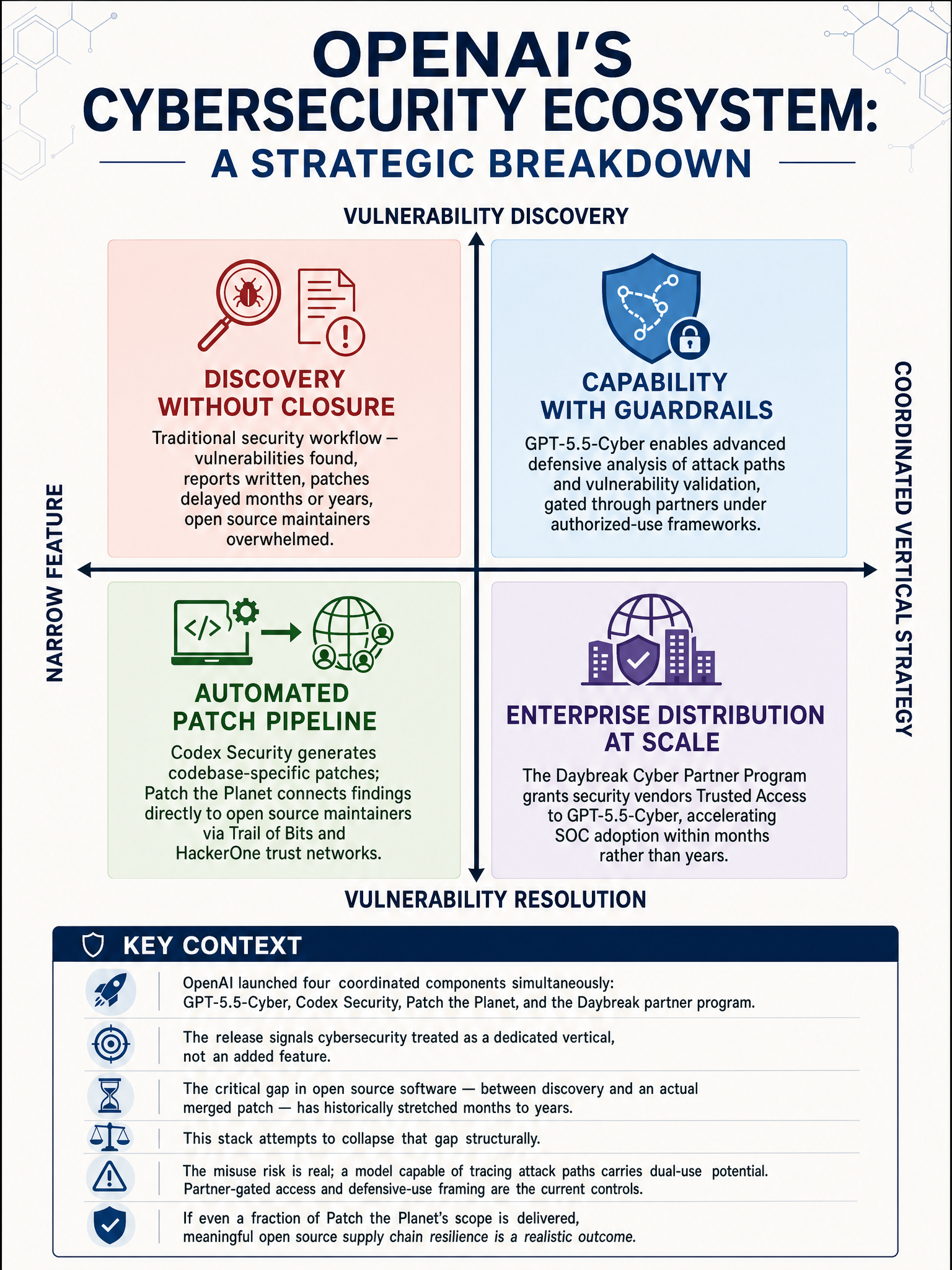
OpenAI shipped three connected things at once. GPT-5.5-Cyber is the model. Codex Security is the workflow layer. Patch the Planet is the program that connects AI findings to actual human maintainers who can merge fixes.
Codex Security lets teams run deep scans, validate findings, trace attack paths, build threat models, generate codebase-specific patches, and export into tools they already use. That’s not a chatbot wrapper. That’s a full defensive pipeline.
And then there’s the Daybreak Cyber Partner Program, which lets security software and services providers use GPT-5.5 with Trusted Access for Cyber inside their own products. OpenAI is building infrastructure here, not just shipping a demo.
The Open Source Gap Nobody Talks About
Patch the Planet is the piece that deserves more attention than it’s getting.
The traditional security workflow is: find a vulnerability, write a report, file a ticket, wait. In open source software, that wait can stretch to months or years. Most open source maintainers are one or two people with day jobs. A CVE sitting in their backlog is not a priority when rent is due.
OpenAI is partnering with Trail of Bits, HackerOne, and researchers to bring Codex Security into the actual remediation process, with human oversight built in. The goal is to move from “finding” to “merged fix” at something closer to machine speed.
That phrase, “machine speed patching,” would have sounded like vaporware two years ago. It doesn’t anymore.
Sam Altman put it plainly: “We want to help all companies be secure.” That’s an ambition statement, not a product feature. Whether it holds up depends on execution, but the architecture they’ve built at least points in the right direction.
My Take on What This Changes
I’ve watched the security tooling space absorb AI slowly and awkwardly for a few years now. Most of what gets shipped is fancy grep with a chat interface. What OpenAI is describing here is different in kind, not just degree.
The Codex Security plugin sitting inside the development environment, catching and patching as you build, changes where in the software lifecycle security actually lives. Right now security is a gate at the end. This pushes it left, hard.
The risk I’d flag is over-reliance. Automated patch generation sounds great until a model generates a patch that fixes one vulnerability and quietly introduces another. The “human review” part of this system has to be real, not a checkbox. OpenAI’s language about evidence preparation and human oversight is reassuring, but I’ll want to see how that holds in practice as teams inevitably start rubber-stamping the AI’s suggestions.
🔐
What Comes Next
The Daybreak Partner Program is the part I’m watching most carefully. If major security vendors integrate GPT-5.5 with Trusted Access into their products, OpenAI becomes infrastructure for the entire enterprise security stack. That’s a different business than a chatbot subscription.
The open source angle through Patch the Planet could be genuinely consequential for software supply chain security, which is where a lot of the real risk lives right now. Getting fixes into unmaintained or under-maintained packages faster is a concrete, measurable outcome. I hope they publish numbers on merged patches over time, because that’s the only scoreboard that matters.
AI finding vulnerabilities is table stakes at this point. AI helping close them, at scale, with the maintainer ecosystem actually involved, that’s the harder problem. OpenAI is at least asking the right question.
Sources
#cybersecurity #OpenAI #AI #softwaresecurity #opensource #GPT5