Pew Research: 52% of Americans more concerned than excited about AI, up from 37% in 2021, with young adults leading skepticism over job displacement
The Majority Has Spoken. Are We Listening?
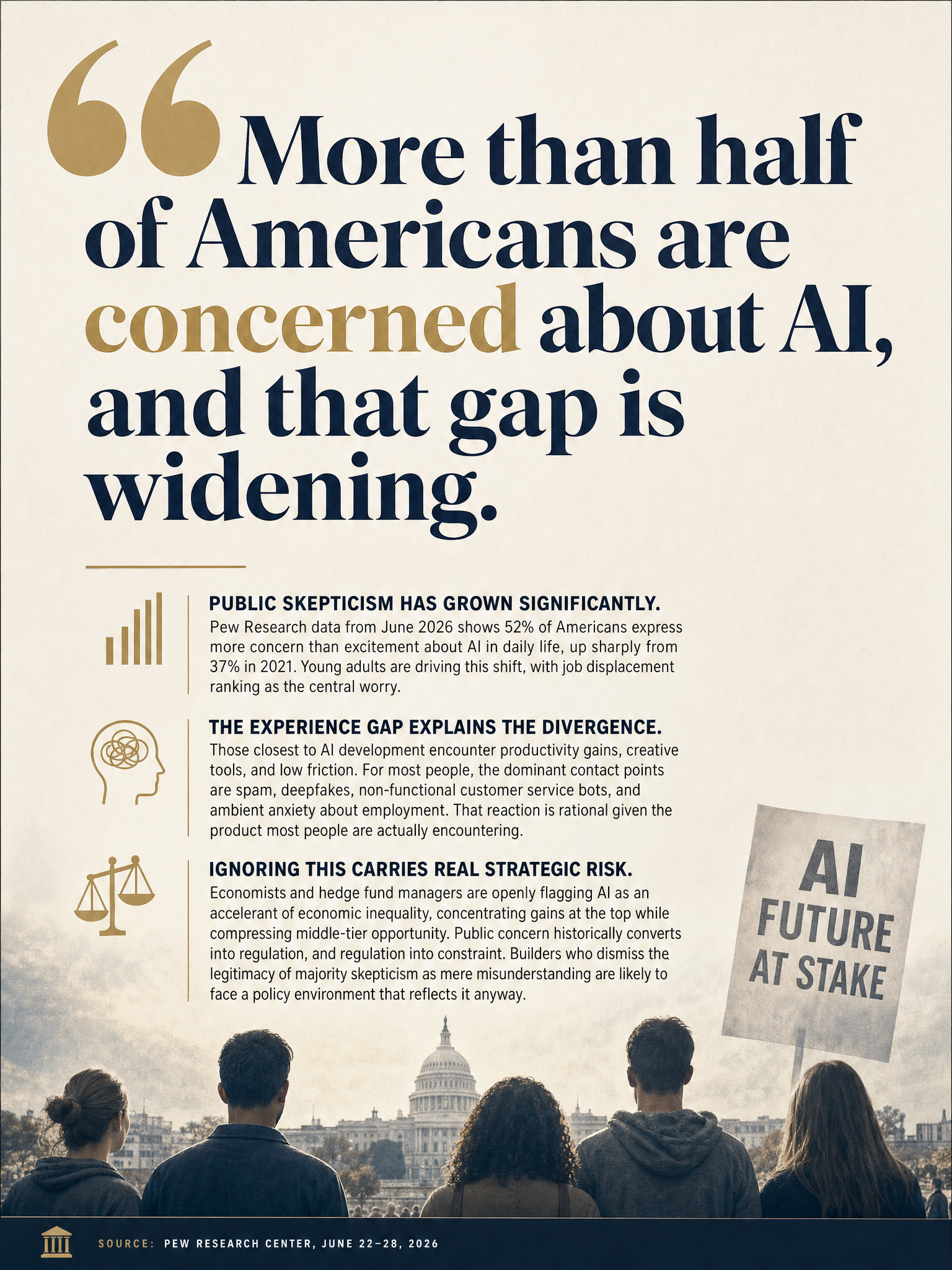
52% of Americans now say they are more concerned than excited about AI in their daily lives. That number is from Pew Research, survey conducted June 22-28, 2026. In 2021, that same figure was 37%. So in five years, while we shipped GPT-5.6, Claude Sonnet 5, Gemini 3.7, and a thousand other things that made us collectively gasp at benchmark charts, the percentage of the American public trending toward concern grew by 15 points.
That is not a rounding error. That is a direction.
🔢 What the Numbers Actually Say
The full Pew breakdown is worth sitting with. Only 9% of Americans are more excited than concerned. 37% say they are equally excited and concerned. The majority view, the 52%, sits squarely in the worried column. And the group leading that skepticism is young adults, the demographic we assumed would be the natural adopters, the ones who grew up with this stuff.
Their primary concern is job displacement. Not sci-fi robot uprisings. Not surveillance states. Jobs. The thing that pays rent and structures identity and gives people a reason to get up in the morning. That is a concrete, grounded fear, and it is coming from people who have the most working years ahead of them.
The Washington Post reported this month that economists and hedge fund leaders are warning AI is already widening economic inequality, concentrating gains among the wealthiest individuals and cities. So young adults are not imagining this risk. They are reading the same signals.
🧠 The Builder Bubble Is Real
I spend a lot of time in AI circles. I build things. I follow the release cadence obsessively. Claude Sonnet 5 dropped June 30 with a million-token context window. GPT-5.6 came nine days later in three tiers. Gemini 3.7 Flash landed August 13 targeting coding and business automation.
Every one of those launches generated enormous energy inside the community. Posts, threads, benchmarks, hot takes. Mine included.
But here is what I notice: that energy is almost entirely self-referential. We are excited about the thing we are building, for audiences who are already excited about the thing we are building. Meanwhile, the broader public is moving in the other direction. The gap between builder sentiment and public sentiment is not closing. It is widening.
That should be uncomfortable. I find it uncomfortable.
Why the Usual Responses Fall Flat
The standard playbook when numbers like this come out goes something like: “People always fear new technology.” Or: “They just need more exposure.” Or: “The jobs will come back, they always do.”
I am skeptical of all three.
Fear of new technology is not irrational when that technology demonstrably automates tasks faster than labor markets can absorb the displacement. The reassurance that jobs will return requires a level of certainty about the future that nobody, not economists, not AI labs, not hedge fund managers, actually has. And the exposure argument assumes that the product experience itself builds trust. But when Anthropic’s primary move toward transparency this month was adding invisible watermarks to Claude using Google’s SynthID technology to comply with European regulations, that is a compliance story, not a trust story.
These are not the same thing.
What Actually Needs to Happen
I think the honest answer is that we have not built the public relationship that matches the ambition of what we are building. The launches are fast. The safety communications are slow. The economic benefits are real but concentrated. The displacement concerns are real and broadly distributed.
USC engineers published work this month on tools to audit and monitor AI agents before they act, catching risky behavior before it propagates. That is the right instinct applied to a narrow technical problem. We need the same instinct applied at the societal level. What are the equivalent structures that let the public audit whether AI is working for them, not just at them?
That question does not have a clean product answer. But until more of us are asking it seriously, the Pew numbers are going to keep moving in the same direction.
The survey result that sticks with me most is the 9%. Only 9% of Americans are more excited than concerned. That is the size of our current constituency for genuine enthusiasm. If we want that number to move, we have to earn it.
Sources
#ArtificialIntelligence #AIPolicy #TechEthics #MachineLearning #FutureOfWork
Sources & Further Reading
- Young adults in the U.S. are increasingly wary of AI, concerned it will take jobs
- A new force is increasing inequality in America
- Anthropic adds invisible watermarks to Claude using Google tech
- Giving AI Agents the Keys? USC Engineers Develop Tools to Audit and Monitor AI Agents
- Claude Sonnet 5 vs GPT-5.6 vs Gemini 3.7 Flash [2026]