OpenAI GPT-5.6 Sol launch: cybersecurity-focused frontier model with Terminal-Bench 2.1 SOTA, 700K GPU hours of safety testing, limited government-approved preview
OpenAI Just Shipped a Cybersecurity Model. That’s a Different Kind of Announcement.
When OpenAI drops a new model, the usual pattern is a general-purpose leap with some benchmark numbers attached. GPT-5.6 Sol breaks that pattern. This is a domain-specific frontier model, purpose-built for cybersecurity, and the framing around it tells you more than the benchmarks do.
I want to talk about what’s actually happening here, because the implications run deeper than “new model, better numbers.”
What Sol Actually Is
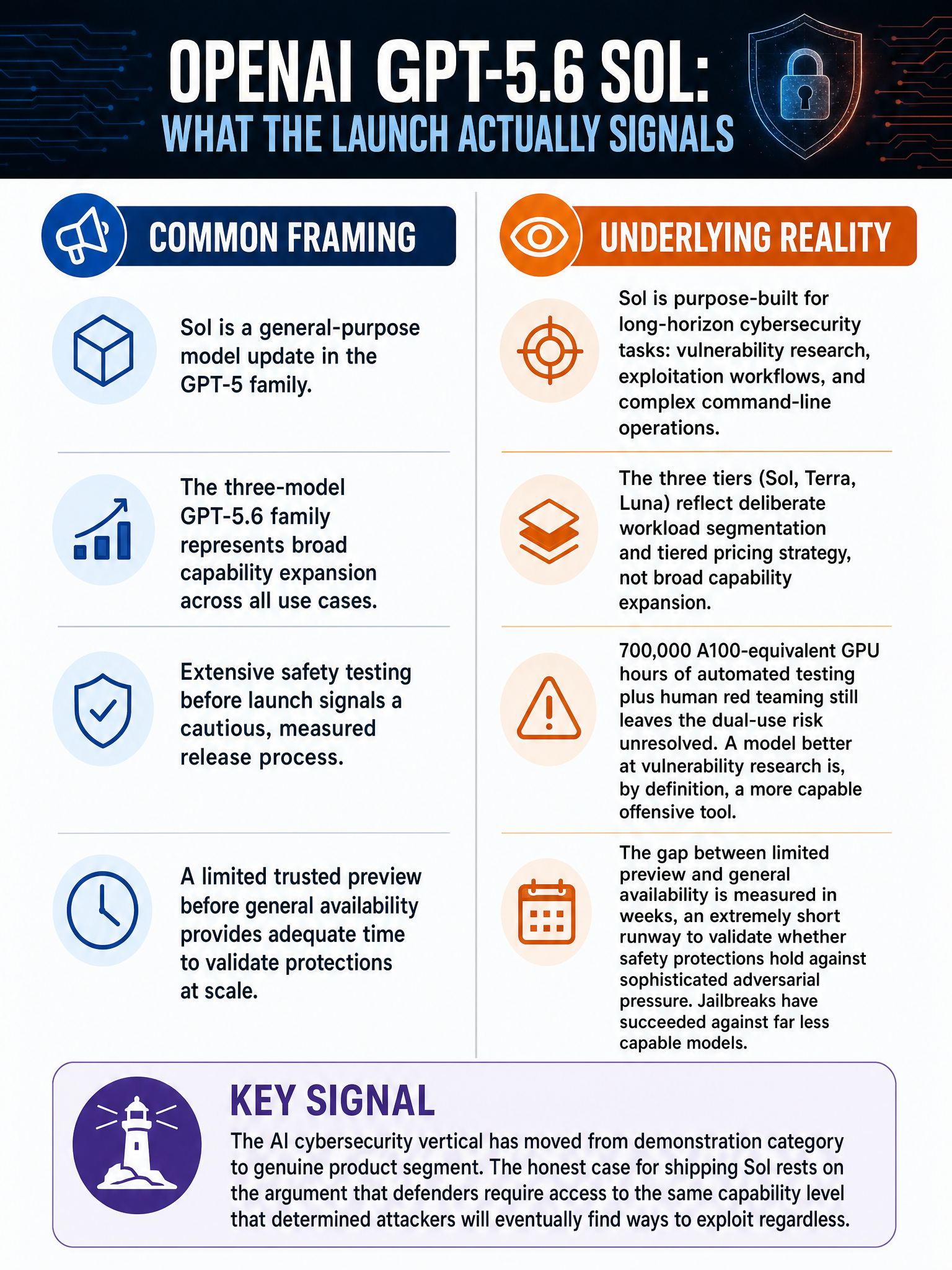
Sol is OpenAI’s new flagship in the GPT-5.6 family, which also includes Terra (a balanced everyday model at 2x lower cost than GPT-5.5) and Luna (a fast, affordable option for high-volume work). But Sol is the one worth watching.
OpenAI describes Sol as purpose-built for “long-horizon security tasks including vulnerability research and exploitation.” That phrase, exploitation, is doing real work there. This isn’t a coding assistant that happens to know about CVEs. It’s a model trained and evaluated specifically for adversarial security workflows.
The benchmark OpenAI chose to lead with is Terminal-Bench 2.1. That’s worth a pause. Terminal-Bench 2.1 tests complex command-line workflows that require planning, iteration, and tool coordination in real CLI environments. It’s not a reasoning puzzle or a knowledge retrieval task. It’s “can this model operate in a real terminal, think across multiple steps, and not get lost.” Sol sets a new state of the art on it.
That benchmark choice is deliberate. It signals what OpenAI wants this model to actually do.
The Safety Stack Is Genuinely Unusual
700,000 A100-equivalent GPU hours of automated testing. That’s the number OpenAI put out publicly. On top of that, human red teaming before launch.
I’ve seen a lot of safety language around model releases. Most of it is vague. This is specific. Whether 700K GPU hours is the right threshold for a model with real exploitation capability is a legitimate question, but at least it’s a number you can argue about. That’s progress over the usual boilerplate.
OpenAI also says they “strengthened real-time protections against high-risk cyber activity and repeated misuse.” The “repeated misuse” part is interesting. It suggests they’re thinking about detection across sessions, not just per-prompt filtering.
The Government Preview Situation
Here’s where I think people should slow down and actually read what happened. OpenAI states plainly: “At the request of the U.S. government, we’re starting with a limited preview among a small group of trusted partners in Codex and the API.”
That’s not OpenAI unilaterally deciding to gate access. The U.S. government asked for a controlled rollout before broad availability. OpenAI says general availability is coming in the coming weeks.
This is a new operational pattern. A cybersecurity-focused frontier model that goes to government-adjacent partners first, then opens up. You can read that as responsible coordination or as the government getting first-mover advantage on offensive security tooling. Probably it’s some of both.
Why the Specialization Trend Matters
Sol is not an isolated product decision. It’s a signal that frontier models are starting to specialize at the capability level, not just the fine-tuning level. The model was designed and evaluated for a specific professional domain from the ground up.
That’s a meaningful shift. General-purpose models that can “also do security” are one thing. A frontier model where Terminal-Bench 2.1 performance is the headline claim is another.
If this works commercially and operationally, expect more of it. Defense, biomedical, financial systems modeling. The question becomes whether domain-specific frontier models with dual-use risk get the same public scrutiny as general-purpose releases, or whether the specialization makes the safety conversation easier to narrow down and close off.
My read: specialization makes the capability conversation easier and the safety conversation harder. When you build something that’s genuinely good at exploitation workflows, the “it can be misused” concern isn’t theoretical anymore. It’s the product description.
What Comes Next
OpenAI says broad access is coming soon. When Sol is generally available, the real test begins: who builds on it, what they build, and whether the safety stack holds up against motivated adversaries who have API access and time.
The 700K GPU hours of testing happened before that. The interesting data comes after.
🔒
Sources & Further Reading
#AIEngineering #Cybersecurity #OpenAI #GPT5 #MachineLearning #AIPolicy