Alibaba Qwen3.8-27B laptop-ready model and Qwen3.8 Max open weights launch, and what it means for builders evaluating closed vs. open-weight deployment strategies
Alibaba Just Changed the Calculus on Open-Weight AI. Again.
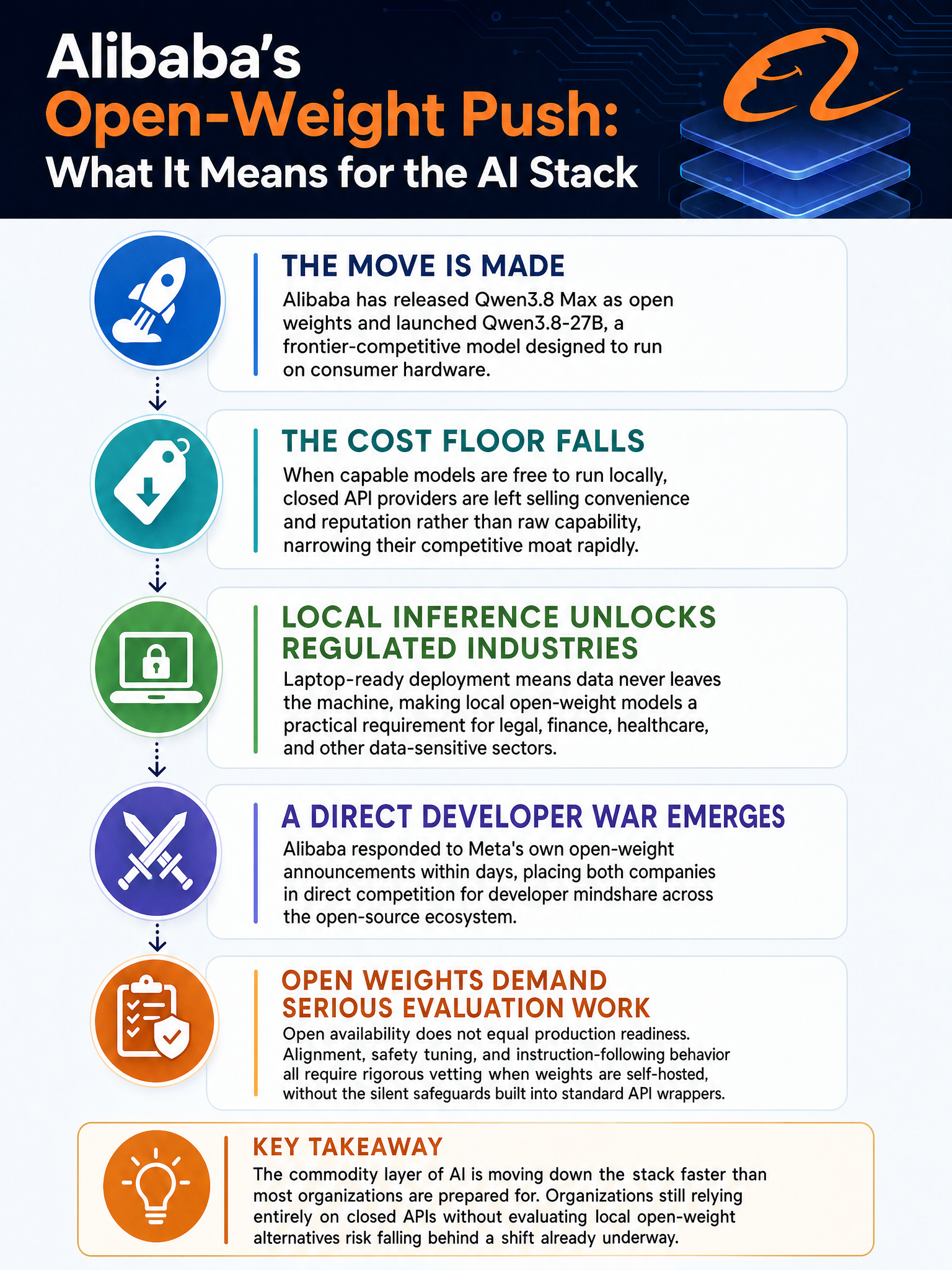
If you missed it, Alibaba launched Qwen3.8-27B on August 17th, designed to run on consumer hardware like laptops, and simultaneously opened the weights on Qwen3.8 Max, its most capable model. That’s two significant moves in one announcement. The laptop-ready model drops the compute barrier to near zero for individual developers. The open weights on the flagship give the research and builder community access to something that would have cost serious money to run via API just eighteen months ago.
This is not a minor release. This is a strategic posture.
🔍 The Meta Playbook, But Faster
Meta proved with Llama that open weights are a distribution strategy disguised as generosity. You seed the ecosystem, get millions of developers building on your architecture, and suddenly your model is everywhere. Alibaba is running the same play, but with a harder push on the hardware accessibility angle.
Running a 27-billion parameter model on a laptop is not trivial engineering. Getting that to work well enough that builders actually choose it over a cloud API call means serious work on quantization and inference optimization. Alibaba did that work. According to CNBC, the move directly answers Meta’s recent open-source AI push and is aimed at maintaining Alibaba’s lead in the open-weight space.
That’s a race worth paying attention to.
Why This Matters for Builders Right Now
Here’s the practical reality. If you’re building a product today and you’re calling OpenAI or Anthropic per token, you have a scaling cost that compounds as you grow. Open weights eliminate that. You download, you fine-tune for your domain, you deploy on your own infrastructure. No API dependency. No surprise billing when you hit a traffic spike. No terms-of-service change that breaks your product overnight.
The tradeoff used to be capability. You accepted a worse model to get cost control. That tradeoff is shrinking fast. When a laptop-ready model from Alibaba is competitive enough that CNBC frames it as a response to Meta’s frontier push, the capability gap between open and closed is no longer the obvious deciding factor it once was.
The Closed-Weight Moat Is Getting Narrower
I want to be direct about what OpenAI and Anthropic are actually selling at this point. It’s not raw model capability alone. It’s trust infrastructure, safety reputation, enterprise compliance tooling, and ecosystem integration. Those things have real value, especially in regulated industries. I’m not dismissing them.
But the moat is narrowing. When the most capable open models are free to download and run locally, the premium for convenience has to be justified on something more durable than benchmark scores. GPT-5.6 Sol is a genuinely impressive release, but so is a model that costs you nothing per inference after the initial setup.
The builders I respect are already running hybrid strategies. Closed-weight APIs for the front-facing, latency-sensitive, brand-critical flows. Open weights for the internal tools, batch processing, fine-tuned specialized tasks. That pattern is going to become more common, not less.
🧠 What I’m Watching Next
Z.ai’s GLM-5.3, which Reuters reports is nearing Anthropic’s Mythos 5 on cyber-defense benchmarks, is another data point in the same direction. The assumption that frontier capability lives exclusively with American labs is increasingly hard to defend. Alibaba’s move this week and Z.ai’s announcement within days of each other is not coincidence. There’s a coordinated push happening in the Chinese AI ecosystem to establish open-weight credibility at the frontier level, and it’s working.
For builders evaluating deployment strategy right now, the question isn’t open versus closed anymore. It’s about which combination fits your latency requirements, your compliance posture, and your cost model at scale. The infrastructure answer has changed. Make sure your architecture reflects that.
The laptop is the new server. Act accordingly.
Sources
#OpenWeightAI #MachineLearning #AIStrategy #Qwen #BuildersInAI