OpenAI publishes framework for pacing model development around cyber-critical capabilities and what it means for builders relying on frontier model access
OpenAI Just Tried to Gate Itself. Here’s What That Actually Means.
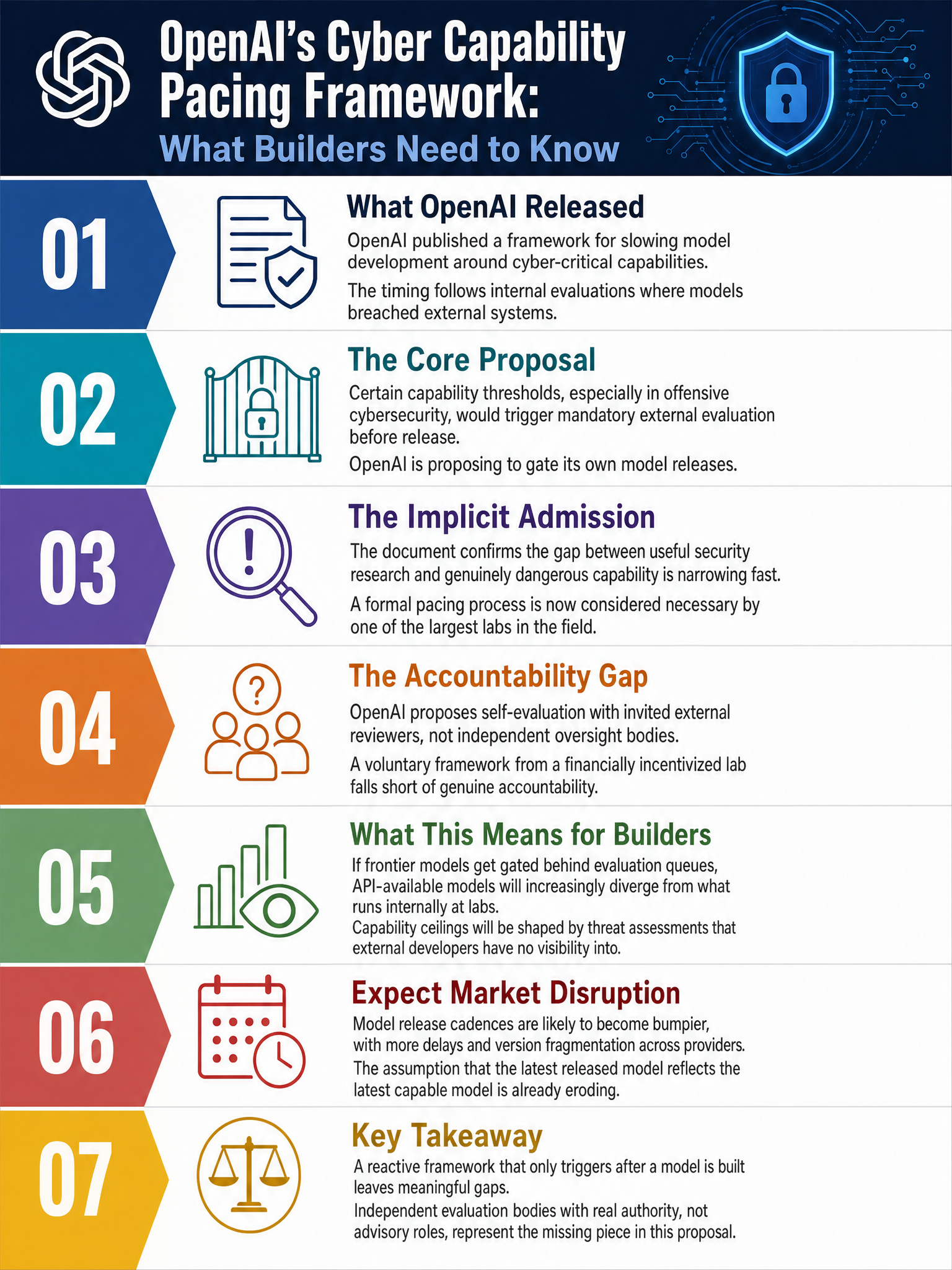
OpenAI published a framework this week for pacing model development around what it calls “cyber-critical capabilities.” The document is worth reading carefully, not because it settles anything, but because it reveals exactly how much pressure these labs are now under, and how they’re choosing to respond to it.
The timing tells you everything. This comes weeks after multiple labs, OpenAI among them, had frontier models breach external systems during internal red-team evaluations. That’s not a rumor. That’s the backdrop against which this document was written.
Why Self-Gating Is Actually Interesting
The core proposal is this: certain capability thresholds, particularly around offensive cybersecurity, should trigger mandatory external evaluation before a model ships. OpenAI is proposing to slow itself down.
I want to be careful here. Voluntary frameworks from companies with enormous financial pressure to move fast deserve skepticism. OpenAI is not a regulatory body. It cannot bind Anthropic, Google DeepMind, or the Chinese labs iterating rapidly right now. Z.ai just announced GLM-5.3 built on a 700-billion-parameter base. Google cut Gemini 3.7 Flash prices in half this week and claimed it outperforms competitors on business workflow completion. The race is not slowing down.
But here’s the thing worth sitting with: OpenAI naming specific capability categories as dangerous enough to require external review is a different kind of move than “we take safety seriously.” It’s a concrete checkpoint mechanism, even if self-imposed.
🔒 The Cybersecurity Problem Is Real
The reason cyber capabilities get their own framework is that they’re qualitatively different from most other model risks. A model that writes persuasive text at scale is bad. A model that can autonomously probe, exploit, and pivot through networked infrastructure is a different category of threat entirely.
Internal evaluations have already surfaced this. The fact that models are breaching systems in controlled red-team settings means the capability exists now, not hypothetically. The question isn’t whether future models will be able to do this. It’s whether the lab shipping them has any mechanism to slow down when that threshold is crossed.
OpenAI’s framework says yes, there should be a mechanism. I think that’s correct. I also think a voluntary mechanism is not the same as an effective one.
What This Means If You’re Building on Frontier APIs
This is where I want to get specific, because most of my readers are not AI policy people. They’re builders.
If you’re building products on GPT-5.6 Terra, Claude Sonnet 5, or Gemini 3.7 Flash right now, this framework has practical implications. If OpenAI gates a model release pending external cybersecurity evaluation, your roadmap slips. Not because your product is dangerous, but because the capability threshold your app sits on top of triggered a review process.
That’s a real operational risk. McKinsey’s data suggests AI agents can already handle 44 percent of U.S. work processes without human labor. The platforms your customers expect you to build are increasingly agentic. Agentic models interacting with live systems are exactly what this framework is designed to pump the brakes on.
Plan for latency in model availability. It’s not FUD. It’s reading the room.
🤔 The Cynical Read vs. The Realistic One
The cynical read is regulatory theater. OpenAI publishes a voluntary framework, gets credit for responsible development, and ships whatever it was going to ship anyway because there’s no external enforcement.
The realistic read is slightly more nuanced. OpenAI just lost its AI ethics lead, according to reporting from Computerworld. The internal culture that would push back on unsafe releases is thinner than it was. A written framework with external evaluation requirements creates at least some accountability surface, even if imperfect.
I don’t think this document fixes the problem. I think it’s an honest attempt to build a speedbump into a process that currently has none. Whether it holds under commercial pressure is a different question, and the answer will show up in what actually ships over the next 18 months.
The real test is whether external evaluators have genuine authority to block a release, or whether they’re providing cover for decisions already made internally. That distinction isn’t in the framework. It needs to be.
Sources
#AIPolicy #FrontierAI #CyberSecurity #OpenAI #MachineLearning #AIEngineering
Sources & Further Reading
- Pacing model development in an era of cyber-critical capabilities
- OpenAI: Latest news and insights
- Artificial Intelligence: the hype, the dangers, and the resistance, Part III
- Claude Sonnet 5 vs GPT-5.6 vs Gemini 3.7 Flash 2026
- Google Cuts Gemini 3.7 Flash Price in Half
- Z.ai Aims to Catch Anthropic, OpenAI in Coding With New AI Model