Stanford AI agents converted from scientific manuscripts making new discoveries through inter-agent collaboration, and what it means for agentic system architecture
Stanford Just Broke the Single-Agent Mental Model
I’ve been sitting with this paper for a few days now because I think the builder community is underreacting to it.
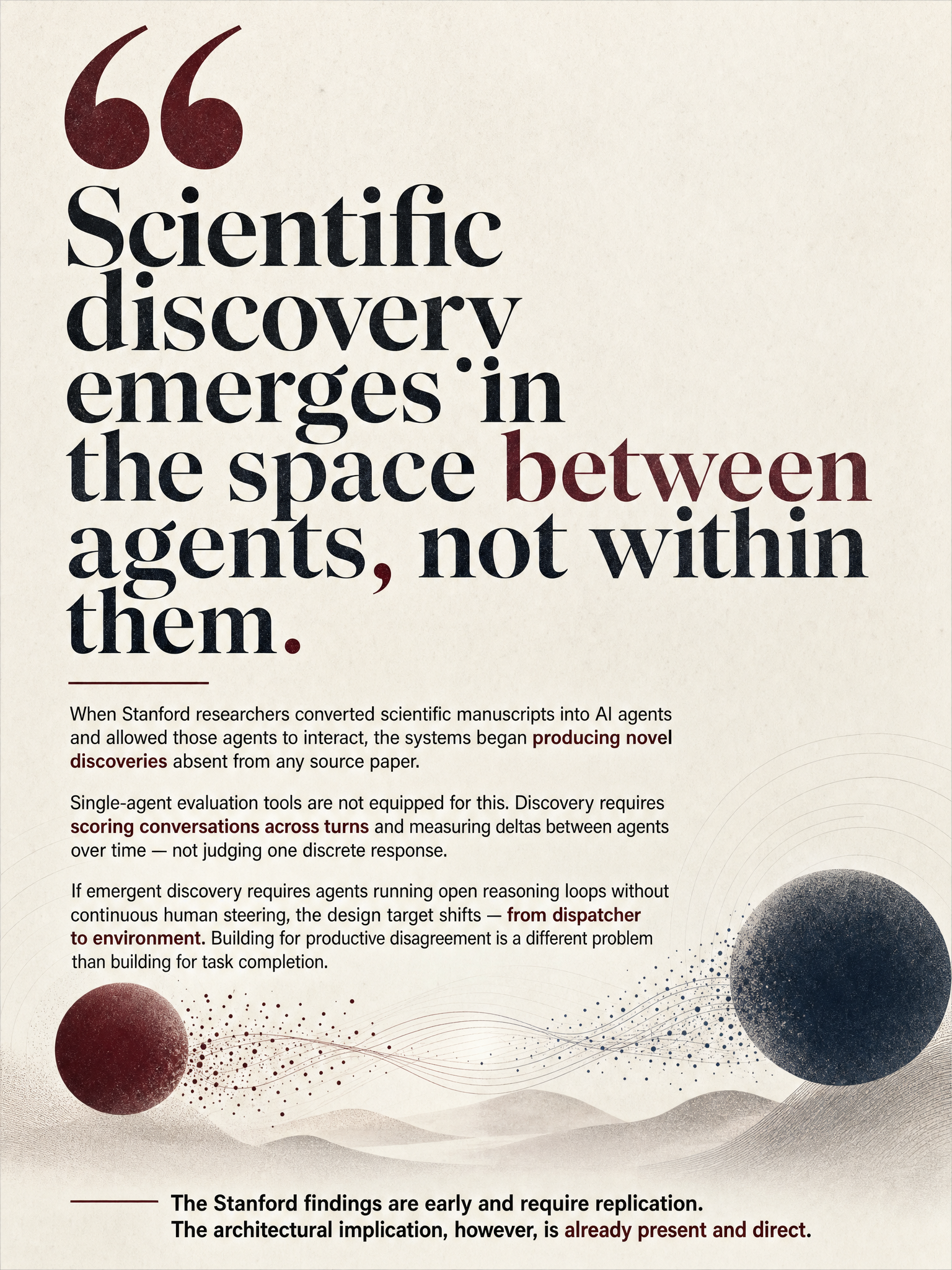
Stanford researchers took scientific manuscripts, converted them into AI agents, then let those agents talk to each other. What came out the other side weren’t summaries or retrievals of the source material. The agents generated novel scientific discoveries that didn’t exist in any of the original papers. Published September 14, 2026.
That sentence deserves a slow read.
🔬 What Actually Happened
The architecture here matters. Each agent wasn’t a generic LLM wrapper. It was instantiated from a specific manuscript, meaning its knowledge, framing, and reasoning patterns reflected that paper’s perspective. When agents with different epistemic origins started communicating, the gaps between their worldviews became generative, not just reconcilable.
This is different from retrieval-augmented generation stitching documents together. This is closer to what happens when two researchers from different labs sit in the same room and argue. The friction produces something neither would have reached alone.
That’s a meaningful architectural distinction, and most of us aren’t building for it.
Why Our Eval Stacks Are Already Outdated
The last two years of agentic development have been almost entirely single-agent focused. Better prompts, better tool use, better retrieval. The benchmark culture we’ve built assumes one agent, one task, one output to score.
When the unit of scientific work becomes a conversation between agents, that entire evaluation model breaks. How do you score an emergent discovery? Which agent gets credit? What’s the ground truth when no human defined the expected output in advance?
I don’t have clean answers. But I think the question itself tells us something. We’ve been optimizing the wrong unit of analysis.
🏗️ What This Means for Agentic Architecture
Most production multi-agent systems today use agents as parallel workers, same task type, split across instances to hit scale. The Stanford result points somewhere different: agents as distinct epistemic identities that produce value through disagreement and synthesis, not just division of labor.
If that framing holds, a few things follow for how we build:
Agent identity matters more than we’ve treated it. An agent’s provenance, what corpus it’s grounded in, what framing shapes its reasoning, stops being an implementation detail and starts being a design decision.
Communication topology becomes a first-class architectural concern. Which agents talk to which, in what order, with what shared context, will likely determine whether emergent outputs are useful or just noisy.
Human oversight has to evolve. Right now most teams review individual agent outputs. When discoveries emerge from agent conversations, you need to review the conversation itself, not just the terminal state.
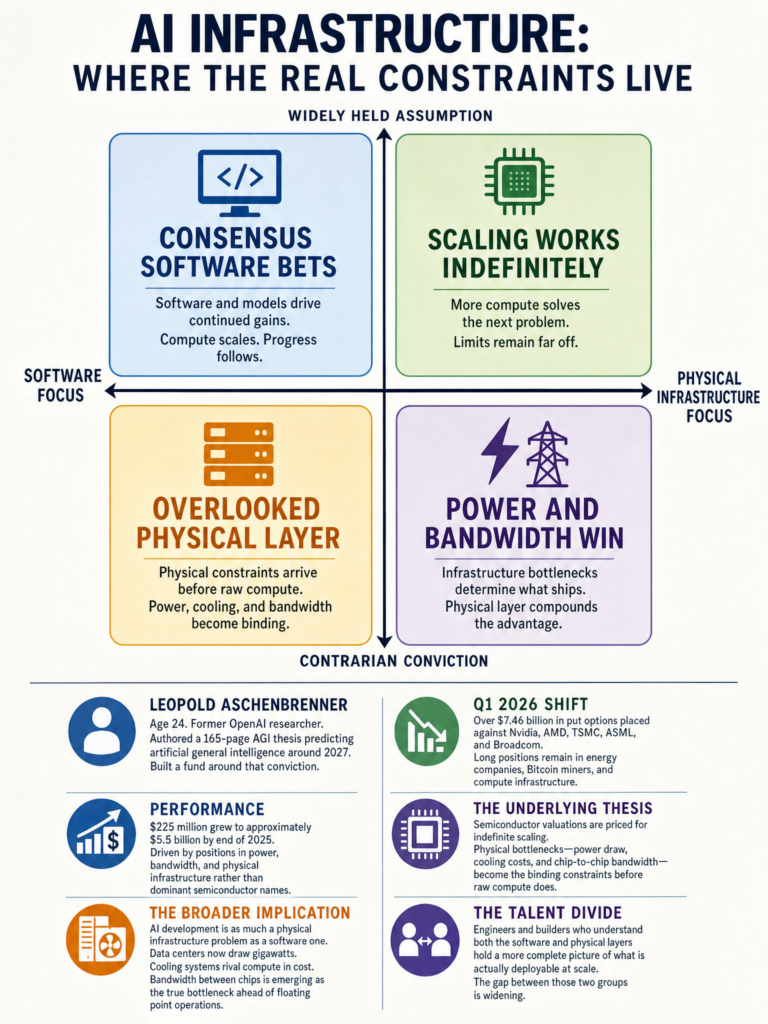
This connects to something Anthropic has been pushing with the Model Hardware Standard, their framework for letting agents control physical lab equipment safely. If AI agents are going to do real scientific work, the oversight problem compounds fast.
The Harder Question
Here’s what I keep coming back to. If inter-agent collaboration can produce genuine scientific novelty, the bottleneck in research stops being human reading speed or hypothesis generation. It becomes our ability to design agent populations with the right diversity of knowledge and the right communication structures.
That’s a systems design problem. It’s also an epistemology problem. And most ML engineers, myself included, haven’t trained for the second one.
The research frontier isn’t moving toward better single agents. It’s moving toward better agent societies. The teams who figure out how to architect those societies, and how to verify what comes out of them, are going to have an outsized role in what science actually gets done over the next decade.
That’s not hype. That’s just where the Stanford result points.
Sources
#AIAgents #MachineLearning #AgenticAI #ScientificAI #MLEngineering #ArtificialIntelligence