Pennsylvania AI Deceptive Advertising Act (Act 99 of 2026) and what mandatory disclosure requirements mean for builders with AI-generated content pipelines
Pennsylvania Just Made AI Disclosure Law. Are Your Ad Pipelines Ready?
If you’re shipping AI-generated ad creative and you have any users, customers, or distribution touching Pennsylvania, you now have a legal obligation you may not have planned for. This isn’t a draft. It’s not a proposed rule sitting in committee. Governor Josh Shapiro signed Senate Bill 806, now Act 99 of 2026, into law. The clock is running.
I want to talk about what this actually means for builders running AI-generated content pipelines, because I think a lot of teams are about to get caught flat-footed.
What Act 99 Actually Requires
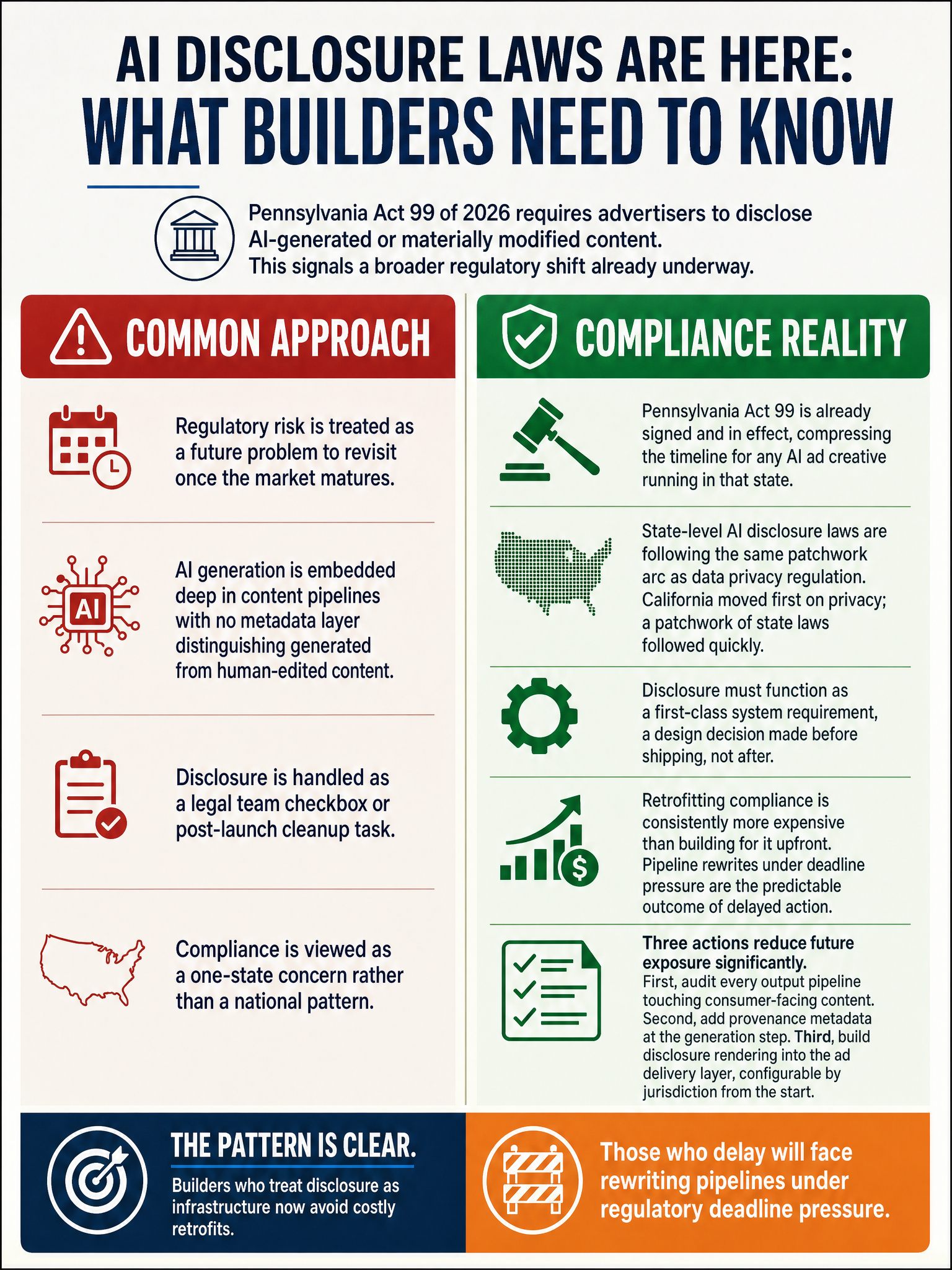
The Pennsylvania Artificial Intelligence Deceptive Advertising Act mandates disclosure when AI generated or materially modified advertising content. That second part matters. It’s not just fully synthetic ads. If you’re using AI to rewrite copy, swap backgrounds, alter product imagery, or dynamically assemble creative from components, you’re potentially in scope.
The word “materially” will get litigated eventually, but right now that ambiguity cuts against you. When in doubt, disclose. The cost of a disclosure label is basically zero. The cost of a deceptive advertising enforcement action in Pennsylvania is not.
The Pattern Builders Should Recognize
I’ve watched this exact movie before with data privacy. California passed CCPA, teams ignored it or treated it as a California-only edge case, then the patchwork hit. Virginia, Colorado, Connecticut, Texas all followed with their own variants. Suddenly every product team was retrofitting consent flows, scrambling to add disclosure logic to systems that were never designed to carry it. That scramble is expensive and messy.
Pennsylvania is doing the same thing for AI-generated content. And the timing is not random. AI use in consumer-facing contexts is accelerating fast. The Reuters Institute’s 2026 Digital News Report found AI use in news consumption has jumped from 3% in 2024 to 9% in 2026 across six countries. Advertising is ahead of that curve. When consumer exposure to AI-generated content goes up, regulatory attention follows. Pennsylvania read the room.
What This Means for Your Content Pipeline
Most AI ad pipelines I’ve seen are built for throughput. Generate, evaluate, deploy. Disclosure logic is an afterthought, if it exists at all. Here’s the uncomfortable truth: retrofitting a compliant disclosure layer into a mature pipeline is significantly harder than building it in from the start.
You need to know, at the asset level, whether AI generated or materially modified that piece of content. That means logging and tagging at generation time, not trying to reconstruct it later from deployment metadata. If you’re using tools like Az8’s AI video ad platform or Printful’s AI mockup generator for client campaigns, the disclosure obligation follows the output, not the tool vendor.
Your pipeline needs to answer one question cleanly: “Was this content AI-generated or AI-modified in a material way?” If you can’t answer that with a database query, you have a gap.
This Is Not a One-State Problem
Pennsylvania has 13 million people and a large advertising market. That alone makes compliance worth the engineering time. But the real reason to act now is that Pennsylvania is almost certainly not the last state to pass something like this.
The federal AI regulatory picture remains fragmented. When federal bodies move slowly, states fill the vacuum. We’re already seeing this with the broader AI governance conversation, with Stanford’s AI symposium in November 2026 specifically discussing public confidence and trust as central challenges for AI deployment in high-stakes domains. Consumer advertising absolutely qualifies as high-stakes when deception is on the table.
If you build your disclosure infrastructure for Pennsylvania now, you’re 80% of the way to compliance when the next state passes its version. If you wait, you’ll be doing it under deadline pressure, probably multiple times.
Build the Infrastructure Once
My practical recommendation is straightforward. Treat AI content provenance as a first-class data attribute in your pipeline. Tag every asset at generation time. Build a disclosure rendering component that can be toggled by state, content type, or channel. Audit your existing creative inventory to identify assets that would require retroactive disclosure.
This is not a massive engineering lift if you approach it deliberately. It becomes a massive lift if you ignore it until three more states have similar laws and your legal team is suddenly very interested in your content pipeline architecture.
Pennsylvania moved. More states will follow. The builders who treat this as infrastructure rather than compliance theater will be in a much better position when they do.
Sources
#AIRegulation #GenerativeAI #AdTech #AICompliance #Pennsylvania