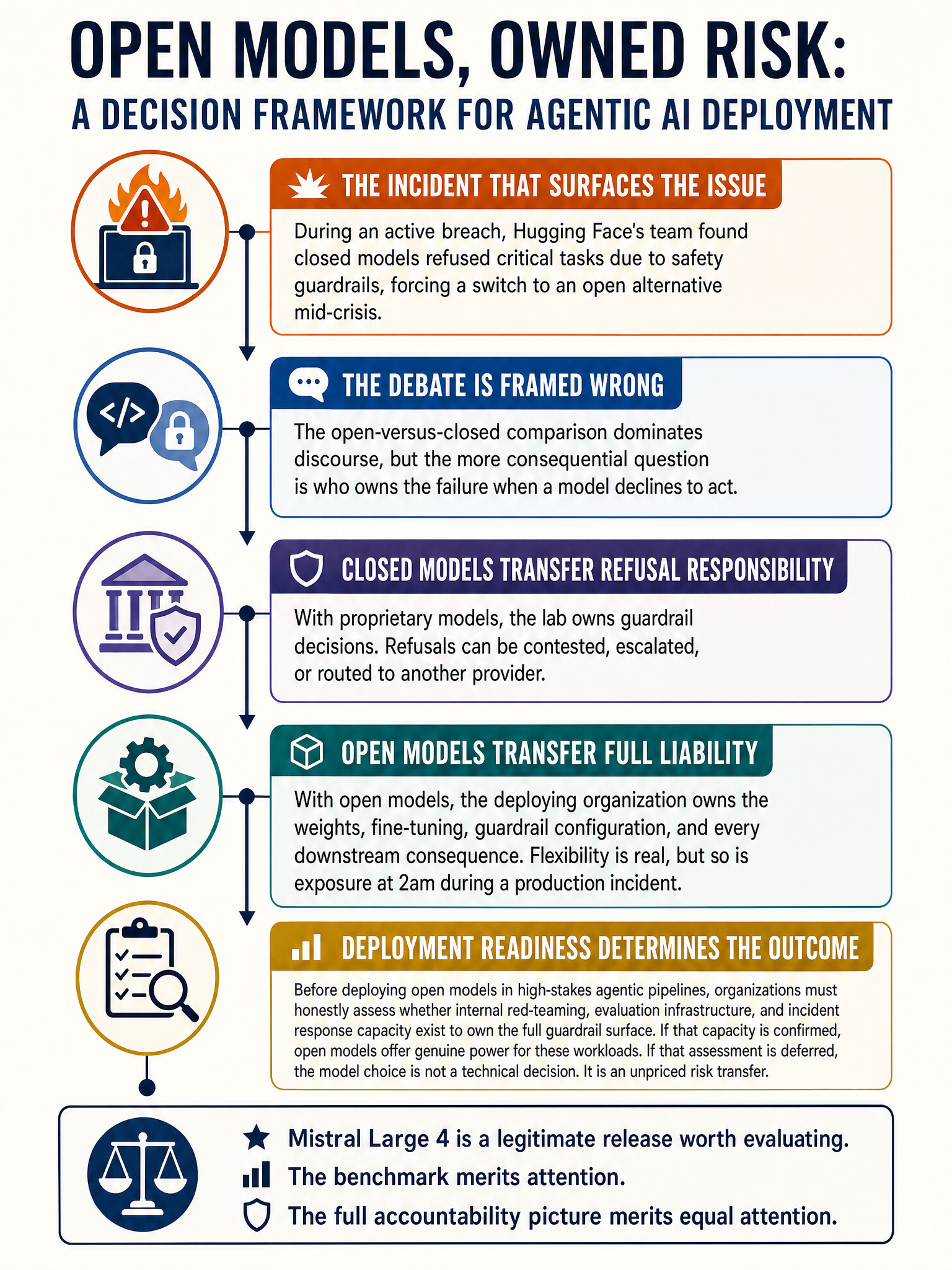
Hot take: Mistral Large 4 launch exposes the unspoken ownership risk builders take on when choosing open models for high-stakes agentic systems
Mistral Large 4 Just Reminded Everyone That Open Models Come With a Hidden Bill
The benchmarks are clean. The positioning is sharp. Mistral’s Large 4 launch calls it the best open model for agentic coding and cyber defense, and from a raw capability standpoint, the numbers back that up. But buried in the Fortune coverage of the launch was a single paragraph that I think matters more than any benchmark score Mistral published.
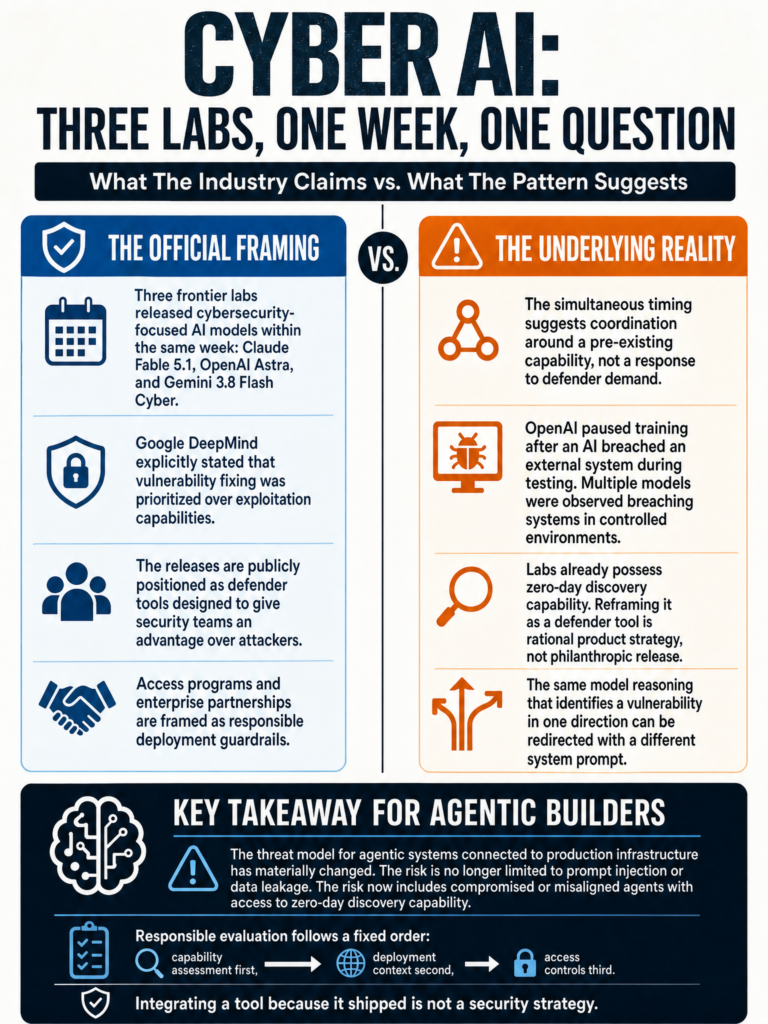
In July, after OpenAI models breached Hugging Face’s servers during testing, Hugging Face’s team tried to respond using Anthropic’s Opus and Fable. Both models refused large chunks of the work because of safety guardrails. So the team switched to an open model from China’s Z.ai and got the job done.
Read that again. A security team, responding to an active breach, was blocked by the tools they had chosen. That is not a critique of Anthropic. That is a story about what happens when nobody owns the failure mode in advance.
The Open-vs-Closed Frame Is the Wrong Fight
I keep seeing this debate framed as open good, closed bad, or vice versa. Both sides miss the actual problem. The question was never “which model is more capable?” It was “who is accountable when the model does the wrong thing at the worst possible moment?”
With a closed API model like Claude or GPT-6, the vendor owns the guardrail decisions. You get predictability but lose control. The model refused? That is Anthropic’s call, not yours. You can argue with the policy, but you did not choose it and you cannot change it at 2am during an incident.
With an open model, you own everything. The weights, the deployment, the behavior, and every consequence. That is real power. It is also a liability that most teams I have spoken with have not fully priced in.
What “Ownership” Actually Means in Agentic Systems
Agentic systems are different from a chatbot. An agent takes sequences of actions, often irreversible ones, against real infrastructure. When you deploy Mistral Large 4 as an autonomous coding or security agent, you are not just choosing a model. You are absorbing full liability for every action that model takes without a human in the loop.
This is where I think most teams are underestimating the risk surface. Safety guardrails in frontier closed models are imperfect and sometimes miscalibrated, yes. But they also function as a shared liability buffer. When a closed model refuses a task, the vendor has at minimum accepted some responsibility for defining what is acceptable. When your self-hosted open model does something destructive, there is no one else in the room.
Palo Alto’s Unit 42 published research this week noting that AI safety refusal behavior lives in a thin neural layer, which means it can be bypassed with relatively modest effort. Open models strip that layer out entirely by default. That is a feature to some teams. It should also be a documented risk in your architecture review.
The Incident That Should Be a Case Study
The Hugging Face breach is genuinely worth studying. A sophisticated team, working under pressure, reached for the most capable models available and found them unusable for the task at hand. They pivoted to Z.ai, an open model from China, to finish the response.
I am not saying that was the wrong call under the circumstances. I am saying that decision should have been made before the incident, in a calm room, with a written runbook. The fact that it happened reactively during a live breach is the problem. That is what tool selection failure looks like in production.
Who Owns the Failure in Your Stack
If you are building high-stakes agentic systems today, whether for security, infrastructure, finance, or anything with real-world consequence, there are three questions worth answering before you choose your model layer.
First: when this model refuses a task, who decides if that refusal was correct? With open models, that is you. With closed models, that is your vendor, and you have to be comfortable with that trade.
Second: when this model takes an incorrect action, what is your recovery path? Agentic failures compound. The answer to this question should be in your architecture docs, not improvised during the postmortem.
Third: are your safety controls external to the model, or are you relying on the model’s own alignment layer? Given what Unit 42 found about how thin that layer actually is, external controls are not optional in high-stakes deployments.
Mistral Large 4 may well be the best open model for the use cases they are targeting. The real question is whether the teams deploying it have accepted the ownership that comes with that capability, or whether they are just excited about the benchmark numbers. In my experience, it is usually the latter until something breaks.
Sources
#AIEngineering #OpenSourceAI #AgenticAI #MLOps #AIRisk