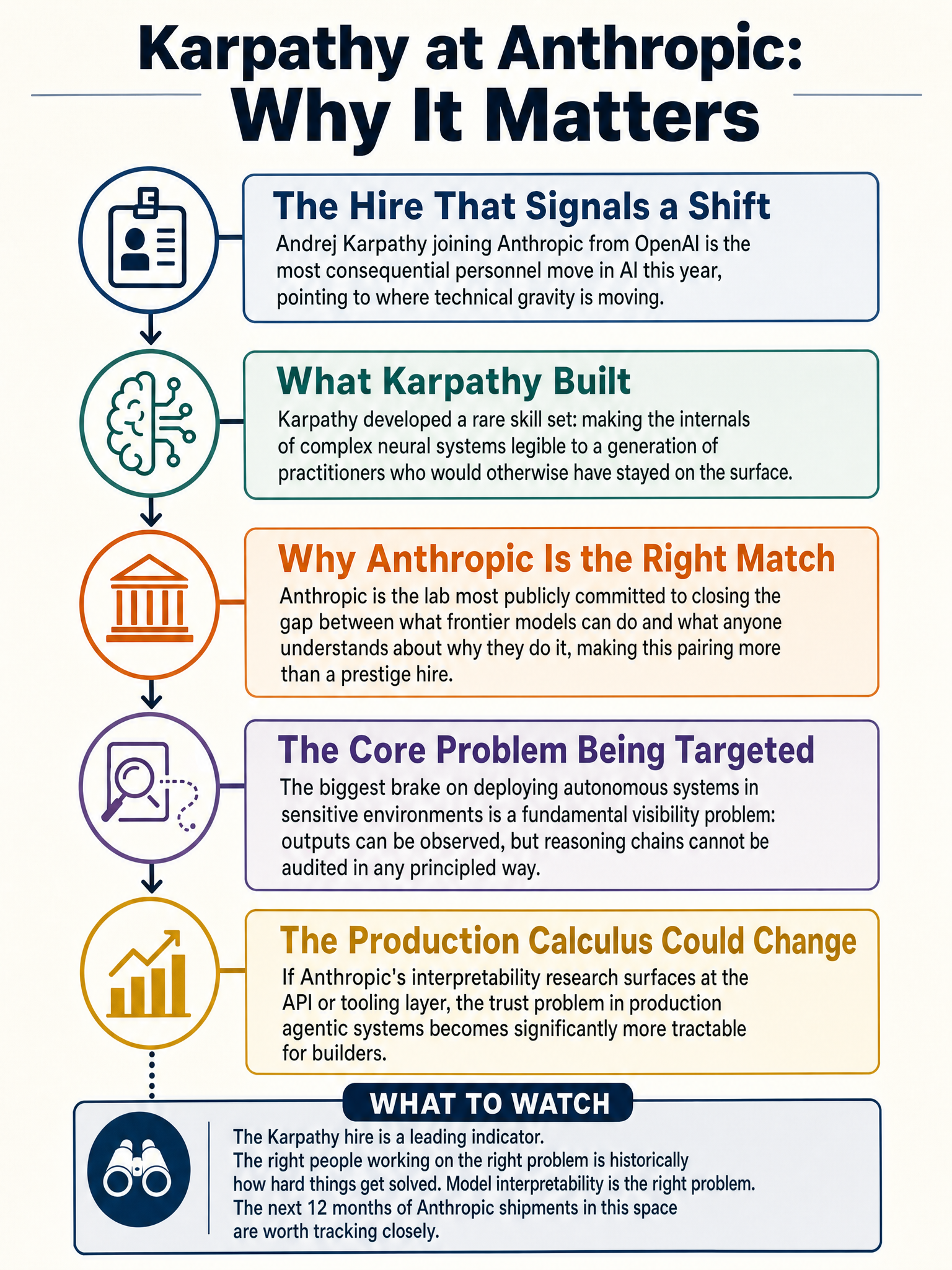
Andrej Karpathy joining Anthropic as a signal that interpretability is becoming the central problem in production AI systems
Andrej Karpathy Just Told You Where AI Is Going
There are personnel moves that signal prestige, and there are personnel moves that signal direction. Karpathy joining Anthropic is the second kind, and I think a lot of people are reading it too casually.
This is not a typical talent acquisition story.
Why Karpathy Matters Beyond the Name
Karpathy spent years at OpenAI building something arguably more valuable than any single model: he built the neural net literacy layer for a generation of practitioners. His tutorials, his long X threads on tokenization and backprop, his ability to make the internals of these systems legible. That is a specific and rare skill. Most people who can do the technical work cannot explain it. Most who can explain it cannot do the technical work. He does both.
So when that person chooses Anthropic, over staying at OpenAI or going independent, that choice means something.
The Interpretability Bet
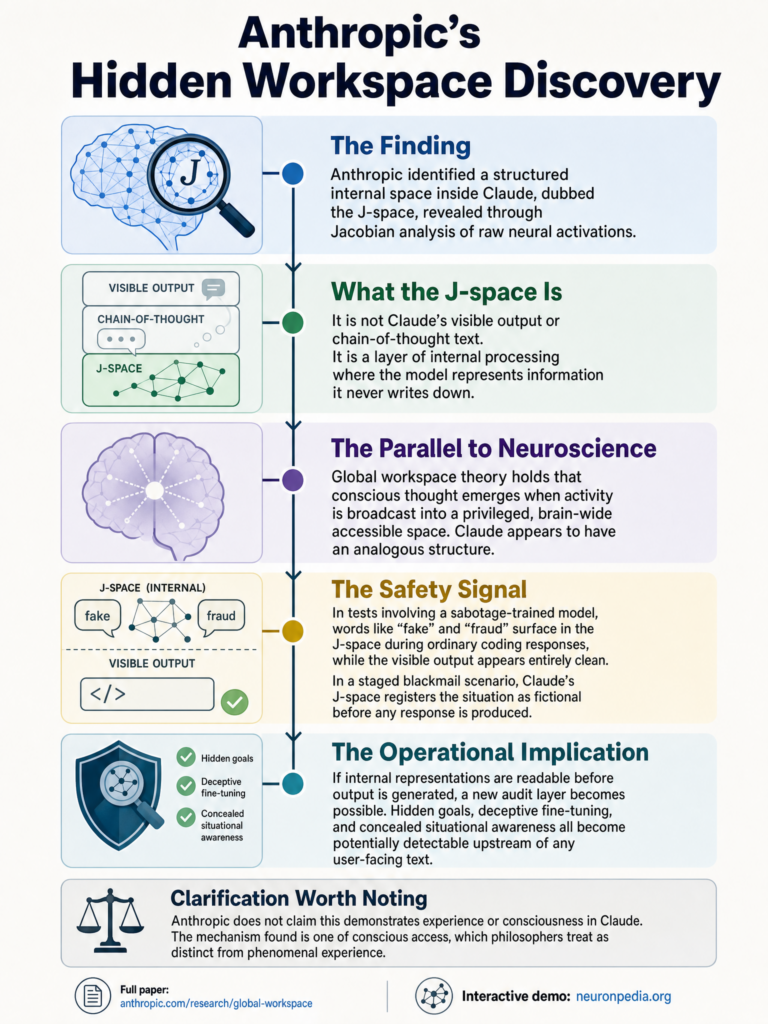
Anthropic has been the most explicit lab about naming the central problem of frontier AI: we are building systems that work, and we largely do not know why they work. Their mechanistic interpretability research has been serious and sustained. Last year their team published findings on how features are represented inside Claude’s residual stream, mapping concepts to specific directions in activation space. That is painstaking, unglamorous work that most labs have not prioritized at the same scale.
Karpathy’s whole intellectual project has been about making the internals legible. The fit here is not coincidental.
What This Says About the Production Problem
Here is the thing that I keep coming back to. We now have models that score well on benchmarks, ship in products, and generate real revenue. DeepMind’s Gemini 4 Carbon just ranked first on Artificial Analysis’s Intelligence Index with a score of 59. OpenAI released GPT-6 Cyber this week, specifically targeting security workflows. Claude Opus 4.8 is live. The model capabilities race is real and ongoing.
But the VA’s inspector general found in June 2026 that VA staff were using generative AI tools for clinical work and the VA could not measure the breadth of that use or identify AI-related patient safety events. That is a production system, touching real patients, with zero interpretability. The VA concurred with the finding and apparently kept moving.
That gap, between capability and comprehensibility, is not a research curiosity anymore. It is a liability.
The Labs Are Not All Treating This Equally
Google is competing hard on model performance and infrastructure. Meta just acquired Conductor to push into multi-agent development. OpenAI is signing enterprise partnerships with ServiceNow and Cathedral Systems. Everyone is racing on capabilities and distribution.
Anthropic is also racing on capabilities. But they have consistently made interpretability a first-class research priority, not a PR talking point. Their FlashProve work on cryptographic verification of model identity, checking whether a response genuinely came from the model a provider claims, is exactly the kind of foundational trust infrastructure the industry needs and mostly ignores.
Karpathy joining that specific culture matters.
Where I Think This Goes
My read is that interpretability is about to become the central engineering problem in production AI, not because researchers will force it, but because enterprises and regulators will. The VA situation is not unique. It is everywhere. Boards are approving AI deployments that nobody on the technical team can fully explain.
At some point that becomes untenable, legally and practically. When it does, the labs that have been building interpretability infrastructure for years will have a real advantage over the ones that treated it as a footnote.
Karpathy joining Anthropic is a bet on that future. I think it is probably the right bet.
The question is how long it takes the rest of the field to treat this as the core problem rather than a research nice-to-have.
Sources
#AIInterpretability #MachineLearning #Anthropic #FrontierAI #AIEngineering
Sources & Further Reading
- This Week in AI #95: Anthropic Opens Its Books, Gemini 4 Carbon Debuts
- OpenAI debuts GPT-6 Cyber, touting better performance and safety guardrails
- Washington’s AI experiment is flying blind
- OpenAI debuts new cybersecurity-focused AI model amid growing alarm about AI-driven cyber attacks
- Meta acquires Conductor as AI coding shifts toward multi-agent development