Contrarian take on AlphaGenome 2 release as a signal that the highest-leverage builder opportunities in 2027-2028 are in biology and science, not software productivity
The Builder Opportunity Nobody Is Talking About
Most builders in the AI space right now are optimizing for the wrong signal. They’re watching token prices drop, reasoning benchmarks climb, and coding assistants ship faster. That’s real progress. But I think 2027 and 2028 belong to something else entirely, and AlphaGenome 2 is the clearest evidence I’ve seen yet.
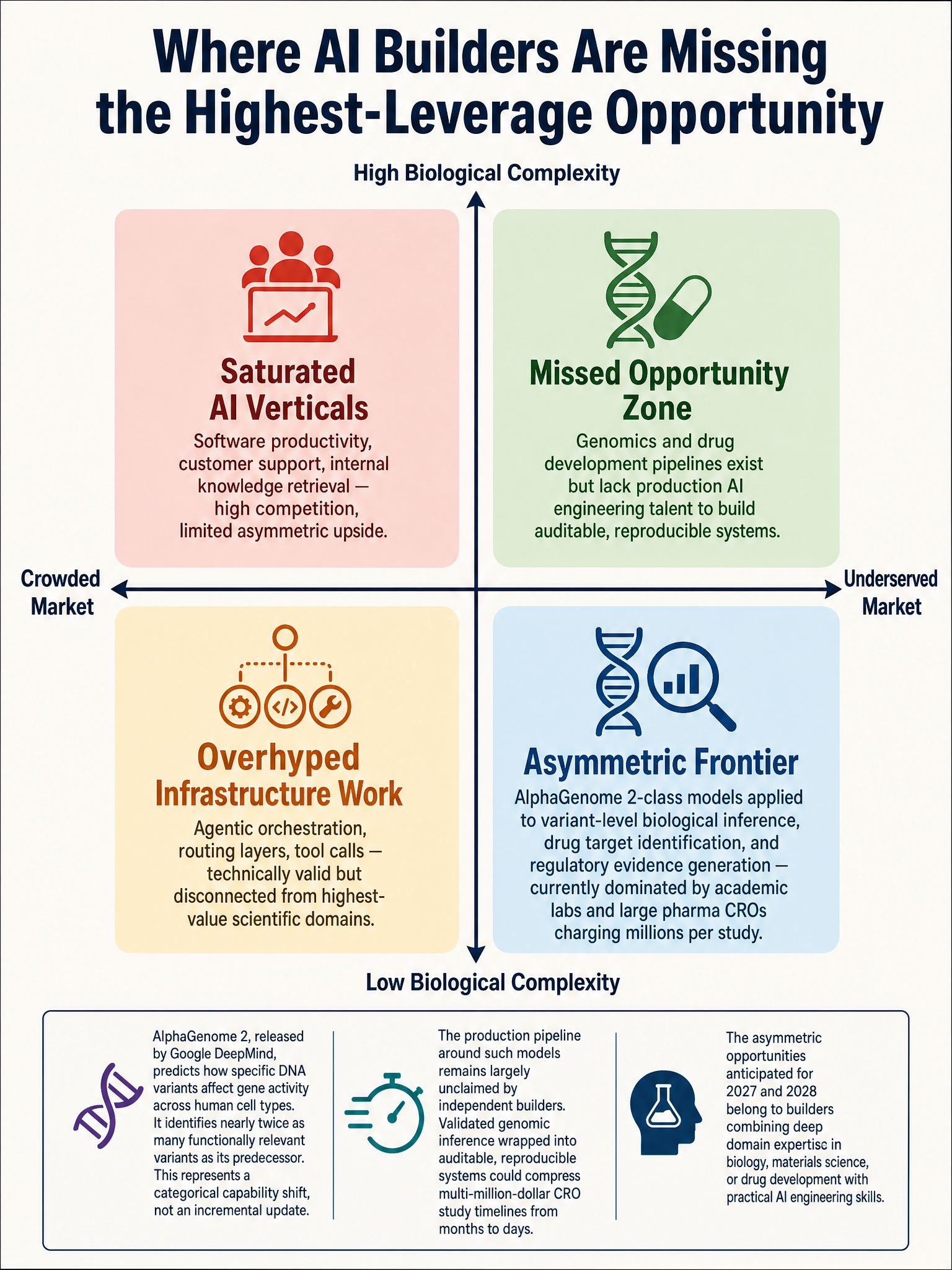
Google DeepMind announced AlphaGenome 2 today at 15:00 UTC. The model predicts how a specific DNA variant changes gene activity across human cell types. The headline stat: it finds nearly twice as many functionally relevant DNA variants as AlphaGenome 1. That’s not an incremental update. That’s a capability threshold being crossed.
🧬
Why Software Productivity Is the Wrong Bet Right Now
I want to be direct about this. The software productivity space is saturated with well-funded, deeply entrenched incumbents. CodeRabbit is shipping 20x more code with agentic workflows built on OpenAI’s stack. Gemini 4 Carbon dropped November 10th aimed squarely at hard coding and research. Claude 5.2 landed November 9th and apparently formalized Fermat’s Last Theorem in 30 hours as a party trick.
The coding assistant space has become a commodity war. Margins are compressing. Differentiation is shrinking. If you’re a builder choosing where to put the next 18 months of your life, chasing incremental improvements in a market already controlled by OpenAI, Anthropic, and Google is a rough proposition.
Biology is different. And right now it’s wide open.
The Gap Nobody Is Closing Fast Enough
Here’s the thing about AlphaGenome 2 that the press coverage is missing. The model itself isn’t the opportunity. The production pipeline around the model is.
Right now, the people who can actually use AlphaGenome 2’s outputs are academic labs and large pharma teams with wet-lab infrastructure to validate predictions. That’s a small, slow-moving user base by software standards. But the validation bottleneck is narrowing, and when it narrows far enough, whoever owns the tooling layer wins.
Think about what a variant-level prediction actually requires downstream. You need data ingestion pipelines for genomic inputs. You need interpretability layers that translate model outputs into something a biologist trusts. You need experiment prioritization logic. You need audit trails for regulatory environments. None of that exists as a clean, composable stack yet. This is exactly where builders should be looking.
🔬
The Acceleration Context Makes This More Urgent
METR published an independent assessment of Anthropic’s R&D pace in October 2026. Their finding: Anthropic is improving model capabilities on well-specified tasks at roughly twice the rate they were achieving between March 2024 and October 2025. They flag high uncertainty, noting the true figure could be anywhere from 1.3x to 3x, but the direction is clear.
If that rate applies even partially to biology-focused models, the window for builders to get in front of the tooling problem is shorter than it looks. The models are moving fast. The infrastructure around them in bio is barely moving at all.
I’ve watched this pattern before with LLMs generally. The models got good, then great, and the people who built the production scaffolding early captured the value. The researchers who trained the models often didn’t.
Who Actually Wins Here
My honest read: the builders who win in bio AI over the next two years won’t be the ones with the deepest biology PhDs. They’ll be the ones who can sit at the junction of model outputs and experimental workflows and build something that a research team actually runs in production.
That means understanding enough biology to know what a scientist needs to trust a prediction. It means building for regulatory audit trails from day one. It means treating the wet-lab scientist as the actual user, not an afterthought.
The model selection question that most builders treat as a technical decision is really a question about which scientific domain is about to have its infrastructure moment. AlphaGenome 2 tells me biology is there. The gap between prediction capability and deployment tooling is wide, the incumbents are slow, and the upside is compressing disease timelines in ways that software productivity tools simply cannot match.
If I were picking where to build in 2027, this is where I’d be.
Sources & Further Reading
#AIstrategy #biotech #genomics #builderadvice #deeplearning