Hot take on Claude Meetings launch and what real-time meeting participation means for production agentic system input architecture
Claude Meetings Is the Architecture Announcement Nobody Is Talking About
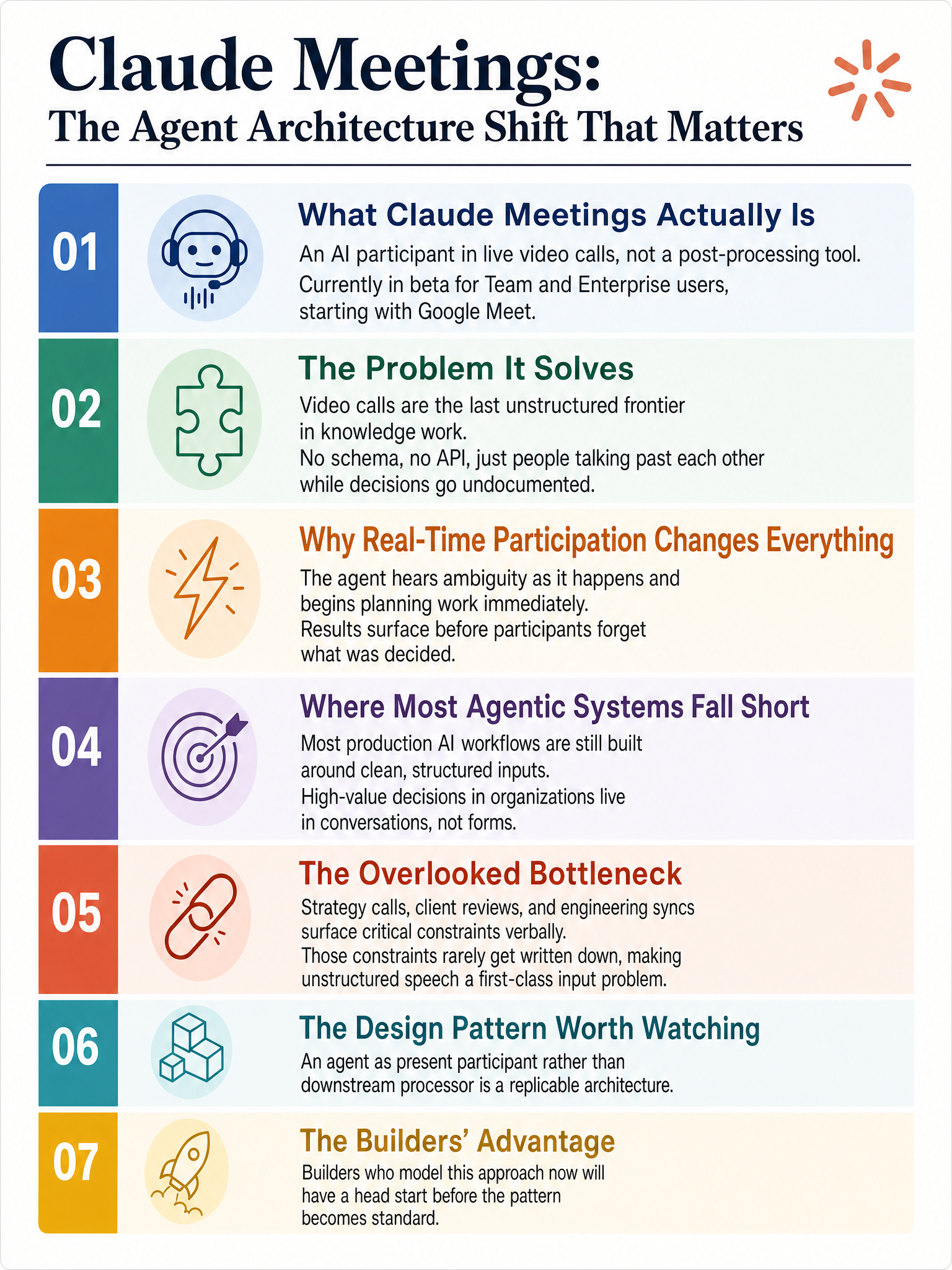
There’s a launch from Anthropic this month that keeps getting buried under IPO coverage and model benchmark wars. Claude Meetings just shipped in beta for Team and Enterprise plans, starting with Google Meet, and I think it’s the most architecturally significant product decision in the agentic AI space this year. Not because the feature itself is flashy. Because it finally answers a question that production AI builders have been quietly struggling with for two years.
Where does an agent actually belong inside a human workflow?
The Last Unstructured Surface
Think about how much of knowledge work has been structured, indexed, or at least made API-accessible. Email threads, tickets, docs, code, CRM records. All of it has some schema underneath. Even Slack messages have metadata you can reason over.
Video calls have none of that. No schema. No clean data model. Just people talking past each other for 45 minutes while someone types bad notes into Notion and half the decisions get made in the five minutes after everyone leaves the room.
That is the last genuinely unstructured input surface in professional work. And dropping an agent into it as a live participant, not a post-processing summarizer, is a fundamentally different architectural choice.
Why the Timing Architecture Matters
The standard pattern for meeting AI has been: record, transcribe, summarize, deliver. That pattern has real value. It also has a structural problem. By the time the summary lands in someone’s inbox, the ambiguity is already baked in. The wrong decision got made, everyone agreed to the wrong scope, and the action items are already pointing at the wrong target.
Claude Meetings does something different. The agent hears the ambiguity in real time, while the humans are still working out what they actually want. It can answer questions in the chat mid-call, which means it’s reducing decision latency inside the meeting itself, not after it. It posts results before anyone’s had a chance to forget or reinterpret what was decided.
That is an input architecture change, not a productivity feature. The agent’s context window starts filling at the same moment the humans start talking. Planning and execution can begin before the call ends.
What This Means for Agentic System Design
I’ve spent a lot of time thinking about where human-in-the-loop fits in production agentic systems. The conventional answer is: you define a structured input, the agent acts, a human reviews the output. Clean and auditable, but it assumes the human can generate a clean input in the first place.
Most real work doesn’t start that way. It starts with a messy conversation where requirements are half-formed and priorities shift three times in twenty minutes. If your agent only enters the workflow after that conversation resolves into a ticket or a doc, you’ve already lost the richest signal available.
Real-time meeting participation means the agent is present for the reasoning, not just the conclusions. That changes what it can plan, how confidently it can act, and how much clarification it needs to ask for downstream.
The 88% Adoption Problem
The Stanford 2026 AI Index found that 88% of surveyed organizations used AI in at least one business function last year, up from 78% the year before. That number sounds impressive. What it hides is that most of that usage is still in the clean, structured layers of work. Document generation, code assist, search, summarization of things that were already text.
The messiest 20% of knowledge work, the part that happens in real-time conversation, has been largely untouched. Claude Meetings is a direct push into that gap. Whether it sticks depends entirely on whether users trust an agent that can actually hear them disagree in real time.
The Harder Problem This Creates
I do think there’s a real challenge here that Anthropic hasn’t fully solved publicly. Real-time participation means the agent is operating on incomplete context, making plans based on a conversation that isn’t finished. That requires a different approach to confidence calibration than you’d use on a closed document. The agent needs to hold its plans loosely and update them as the conversation shifts.
It also means the failure modes are more visible. A bad summary is annoying. A bad mid-call suggestion that derails a conversation is a different category of problem.
That’s worth watching closely in the beta. The architecture is right. The execution risk is real.
We’re at a point where the interesting question isn’t whether agents can do work. It’s whether they can enter the room before the work is defined, and add value there. Claude Meetings is a serious attempt at that. I’d pay attention to how builders start designing input pipelines around it over the next six months.
Sources
#AIEngineering #AgenticAI #ClaudeMeetings #Anthropic #ProductionAI #MLEngineering