Claude Haiku 5.5 release as the most production-relevant model in the Anthropic October 2026 family refresh
Claude Haiku 5.5 Is the Model That Actually Matters
Everyone lost their minds over Opus 5.5. Then GPT-6.1 Sol dropped a week later and the discourse shifted again. Then Gemini 4 Argon landed on September 30th and we were off to the races on another round of benchmark theater. By the time Anthropic quietly pushed Claude Haiku 5.5 on October 7th, most people had already moved on.
That’s a mistake. Haiku 5.5 is the most production-relevant release in this entire wave.
Why Flagship Obsession Is a Trap
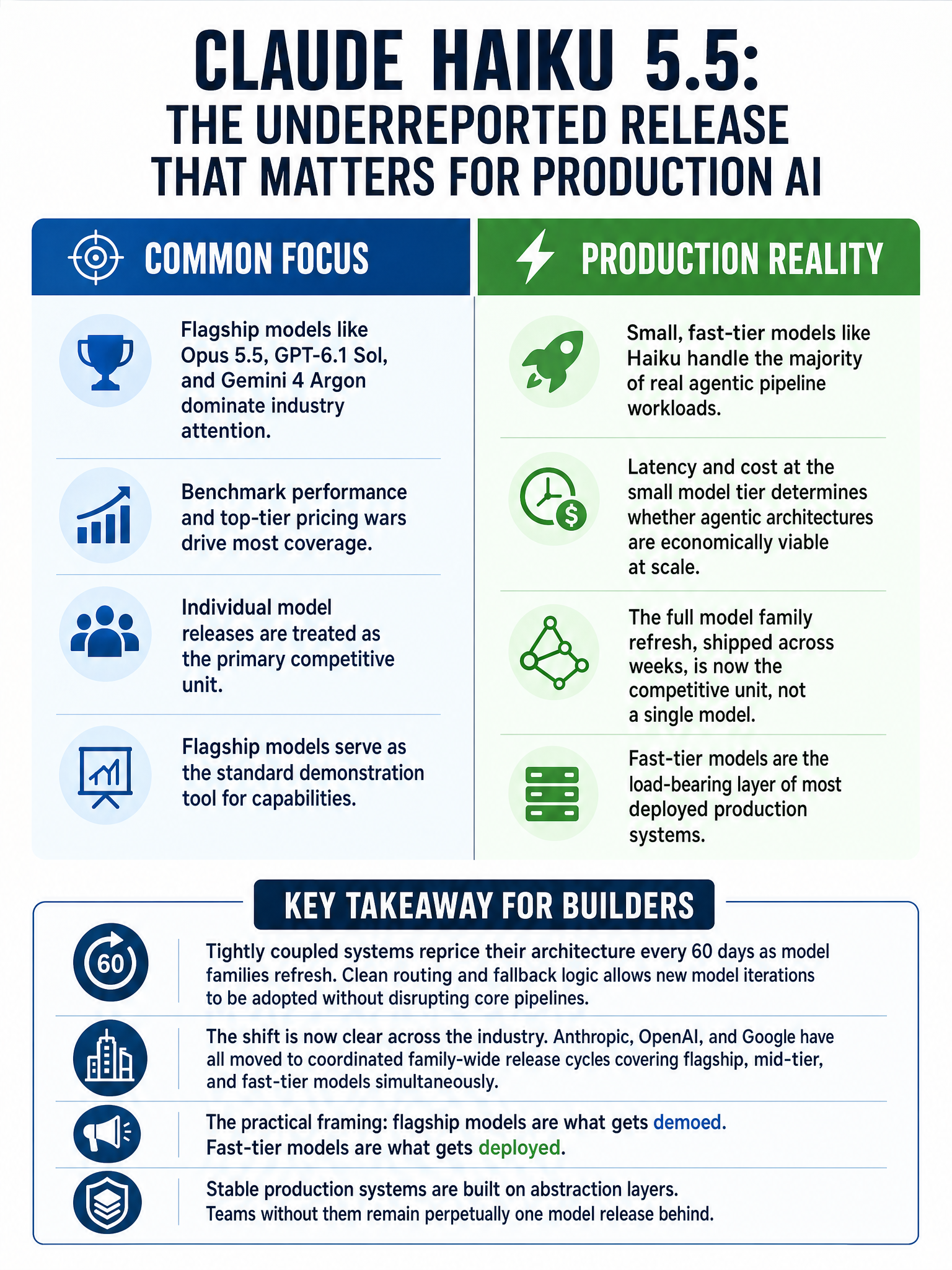
I get it. Opus 5.5 shipped with a reported 1-million-token context window. GPT-6 Astra launched at $10/$50 per million input/output tokens. These are legitimately interesting numbers. But obsessing over them is like buying a Formula 1 car to commute to work. The car is impressive. It just doesn’t reflect how any real workload runs.
Production agentic systems don’t call a frontier model on every step. They can’t. Volume alone makes it economically irrational, and latency makes it operationally impossible. What you actually build is a routing architecture: fast classification nodes, context extraction passes, lightweight decision branches, tool-selection logic. That’s Haiku territory. That has always been Haiku territory.
The Load-Bearing Layer
Eighteen months ago, the small-model tier from the major labs felt like an afterthought. You got a cheaper, dumber version of the real thing, with the rough edges left in. That framing is gone now, and Haiku 5.5 is the clearest evidence of the shift.
Anthropic understands that for any team running serious agentic volume, Haiku is the load-bearing layer. Opus might handle the complex reasoning step, the final synthesis, the user-facing answer. But the ten calls that happen before that? Those need to be fast, cheap, and good enough to not introduce errors into the pipeline. “Good enough” is doing a lot of work in that sentence. Haiku 5.5 has to clear a much higher bar than its predecessors because the systems it now runs inside are genuinely more demanding.
🔍 What This Means for Pipeline Design
If you’re architecting an agentic system right now, Haiku 5.5 changes a few concrete things.
First, the tool-selection and routing calls that previously required a Sonnet-tier model to get right are now plausible at Haiku tier. That’s a real cost reduction on high-volume pipelines, not a marginal one.
Second, the context extraction quality matters enormously in multi-step agents, because errors compound. A weak extraction at step two poisons everything downstream. Getting that right at Haiku’s price point is the thing that makes agentic systems economically viable at scale, not just technically interesting.
Third, the labs are now clearly co-designing these tiers with agentic use cases in mind. That’s a different product philosophy than “take the big model and make it smaller.” It shows.
The Broader Context
This release landed in a noisy October. The Ban Artificial Superintelligence Act was introduced in the US on September 23rd. The EU’s AI Act transparency obligations are in force. There’s no shortage of macro-level AI news pulling attention upward, toward regulation and geopolitics and existential questions.
Meanwhile, teams are in the weeds trying to figure out whether their agent pipelines hold together at production scale. Haiku 5.5 is a direct answer to that problem. That’s a more immediate concern for most builders than anything happening in a Senate committee.
⚡ My Take
The frontier labs have finally internalized something that good systems engineers knew from day one: the expensive model is the fallback, not the default. The September/October 2026 refresh confirmed Anthropic gets this more clearly than anyone. Opus 5.5 is the headline. Haiku 5.5 is the product.
If you’re building right now and you haven’t pressure-tested your routing layer against Haiku 5.5, you’re leaving money on the table and probably adding latency you don’t need.
The real question for the next six months isn’t whether the frontier models get smarter. They will. It’s whether the small-tier models get good enough to collapse the routing complexity entirely. That’s the thing worth watching.
Sources
#AIEngineering #LLMOps #AgenticAI #Anthropic #ClaudeHaiku #MachineLearning #ProductionAI