Prediction: weekly frontier model releases have broken traditional model evaluation cycles, and builders need to architect for permanent model churn
The Release Cadence Is the Product Now
GPT-6 dropped this week. OpenAI called it a “new era of artificial general intelligence.” That phrase is doing a lot of work, and most commentary has focused on the model itself. I think that’s the wrong place to look.
The real signal is what happened around it.
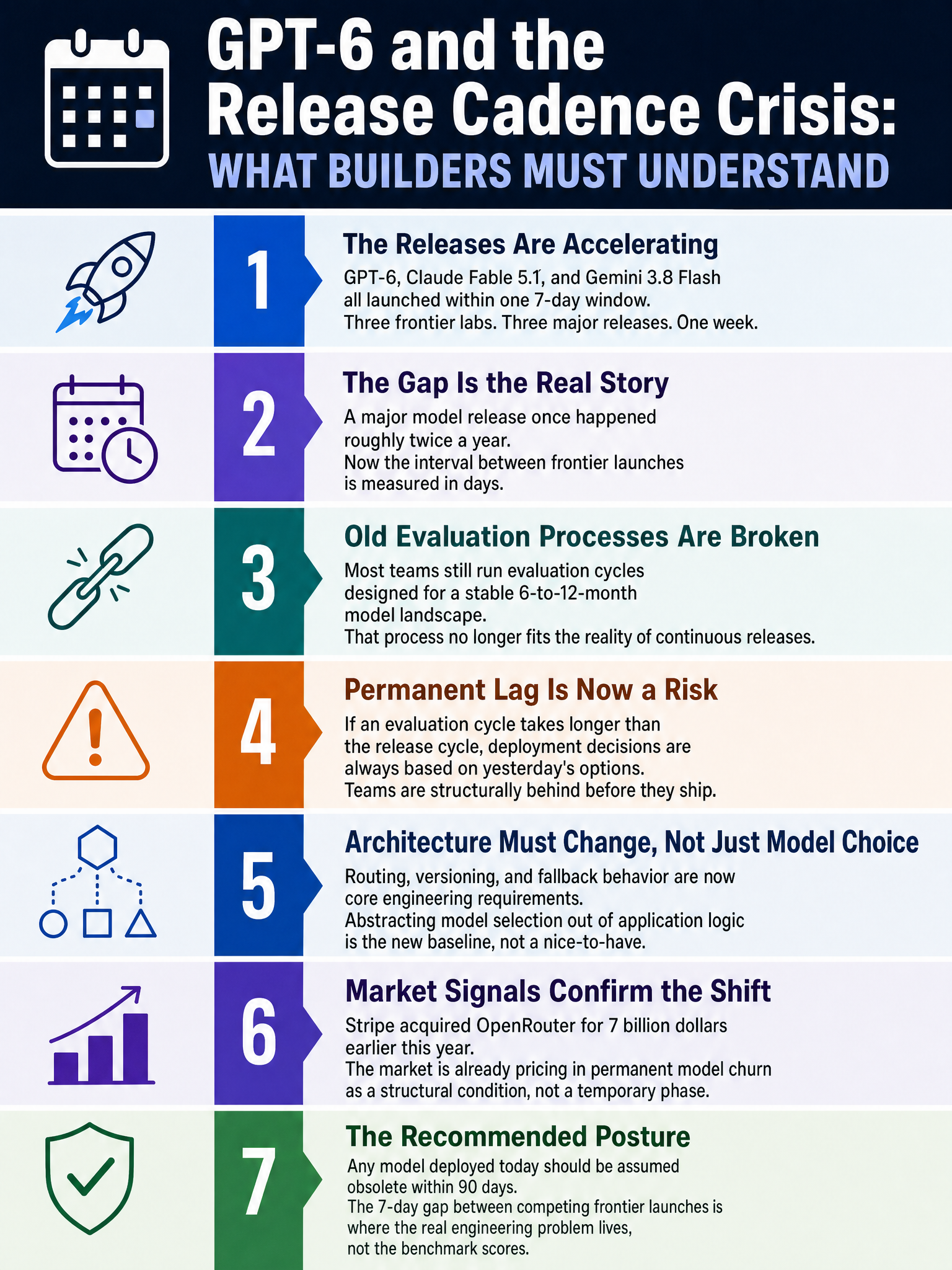
In a single seven-day window: GPT-6 from OpenAI, Claude Fable 5.1 from Anthropic, and Gemini 3.8 Flash from Google DeepMind. Three frontier labs. Three major releases. One week. That is not a coincidence. That is a new operating condition.
When I started tracking these releases seriously, a major frontier model dropped maybe twice a year. You had time to evaluate, integrate, and stabilize before the next wave. That rhythm is gone.
🔁 What Actually Happened This Week
Each release was substantive, not a patch. Anthropic’s Fable 5.1 brought measurable improvements in coding capability, cost efficiency, and safety. Google’s Gemini 3.8 Flash was explicitly designed to close the gap on coding performance against OpenAI and Anthropic, while undercutting on price. OpenAI’s GPT-6 came with cybersecurity-focused capabilities through its “Astra” lineage, including autonomous identification of zero-day vulnerabilities.
These are not incremental. Each one meaningfully reshapes the capability tradeoffs that builders use to make architecture decisions.
The Evaluation Pipeline Is Broken
Most teams I talk to are still running an evaluation process built for a world where the model underneath them stayed stable for six months minimum. You design your evals, run them, make a call, and ship. That process assumed that by the time you finished evaluating, the winner would still be the winner.
That assumption is now false.
If your eval cycle takes three weeks, and frontier releases are coming weekly, you are perpetually evaluating yesterday’s options. You will always be one step behind before you even deploy.
This is not a hypothetical risk. It is the current state.
Why Builders Are Underreacting
Part of the problem is that weekly releases feel like good news on the surface. More capable models, lower costs, more choices. And they are good news, if you can actually use them.
But the teams shipping production AI systems are not primarily bottlenecked on model capability. They are bottlenecked on evaluation confidence. On knowing, with enough certainty to stake user trust on it, that the model they chose will behave the way they expect across their actual workload.
Gemini 3.8 Flash may genuinely match GPT-6 on coding tasks at lower cost, as Google claims. That might make it the right call for your use case. But “might” and “may” are the operative words, and the only way to know is to run your evals. And if you haven’t built that infrastructure to run fast, you won’t know until after you’ve already committed.
⚙️ Architecting for Churn
The teams that will handle this well are the ones treating model selection as a continuous operational concern, not a periodic architectural decision.
Practically, that means a few things.
Abstraction layers are no longer optional. If your application is tightly coupled to a specific model API, every upgrade becomes a migration project. That friction compounds across weekly release cycles into something that actively slows you down.
Eval infrastructure needs to be a first-class asset. Not a spreadsheet, not a one-off script. A running system that can take a new model and give you a real signal against your actual production distribution within hours, not weeks.
Cost and capability tradeoffs need to be tracked dynamically. Gemini 3.8 Flash is explicitly priced to undercut competitors at comparable performance. That is not a one-time offer. Competitive pricing pressure between labs is structural now. Your model selection logic should reflect that.
The Framing That Matters
OpenAI calling GPT-6 a “new era of AGI” is a marketing decision. But the underlying competitive dynamic it reflects is real. Three frontier labs are now releasing on weekly cadences, each explicitly benchmarking against the others, each trying to be the default for builders.
That competition benefits you if you can move fast enough to capture it. If your infrastructure is rigid, it mostly just creates noise.
The builders who come out ahead over the next twelve months will not be the ones who picked the best model this week. They will be the ones who built systems that can swap, evaluate, and redeploy without a crisis every time a new one lands.
And right now, that’s every week.
Sources
#AI #MachineLearning #LLM #AIEngineering #BuildingWithAI
Sources & Further Reading
- GPT-6 Stole the Show, but Anthropic, Meta and Google Also Had New AI Models This Week
- Google takes on Anthropic and OpenAI with Gemini 3.8 Flash
- Anthropic Unveils Enhanced AI Model Claude Fable 5.1
- OpenAI hails new era of artificial general intelligence with Astra
- New Google AI Model Said to Narrow Gap on Coding Ability