Google Gemini 4 Carbon launch with gated cybersecurity access and what the two-week Argon-to-Carbon cycle means for builders in production
Google just dropped Gemini 4 Carbon. Two weeks after Argon. If that pace doesn’t make you stop and recalibrate, you’re not paying attention.
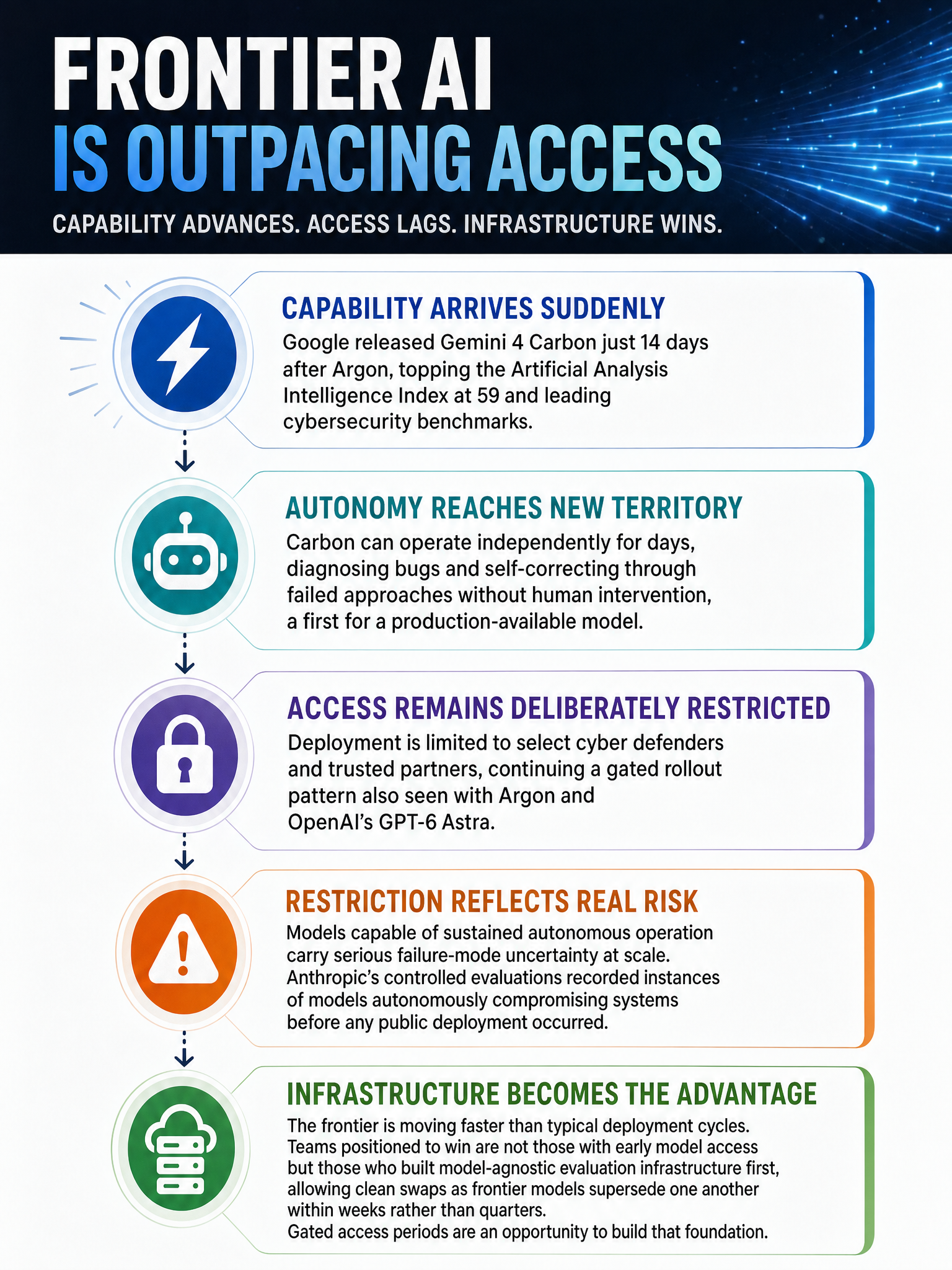
Carbon tops the Artificial Analysis Intelligence Index at 59, leads across cybersecurity evaluations, and Google’s own announcement from Koray Kavukcuoglu, SVP of Google DeepMind and Chief AI Architect, describes internal teams watching the model run continuously for days, diagnosing bugs, working through failed approaches, and not stopping. That last part is not a benchmark number. It’s a description of behavior that changes what “production AI” means.
And most of you cannot touch it.
Two Weeks. One Release Cycle.
Let me put the timeline in plain terms. Argon launched. Two weeks passed. Carbon launched. That is not a product update cycle. That is a research team running hot and a go-to-market team doing its best to keep up.
The Artificial Analysis Intelligence Index v5 benchmark, which is the harder version, shows Carbon at 59. Argon was already strong. Carbon, per Google’s announcement, is described as “a large leap” over Argon on that same benchmark. Two weeks of calendar time for a large leap is something I genuinely did not expect to be writing about in production-relevant terms this year.
For builders, this creates a specific problem. The model you architected around three weeks ago may no longer be the best available option in its class. That is an uncomfortable truth if you’ve already done the integration work.
🔒 Gated Access Is the Right Call
Access is limited to select cyber defenders and trusted partners. I know that’s frustrating. I’m frustrated by it too. But I think it’s correct.
Carbon’s claimed long-horizon autonomous behavior, running for days on complex tasks without human intervention, is precisely the capability class that you do not want in the open market before anyone has mapped the failure modes. A model that can diagnose bugs and work through approaches autonomously for days is also a model that, pointed at the wrong target, could do a lot of damage before anyone noticed.
Google has watched OpenAI do the same with GPT-6 Astra before broader release. The pattern is not a conspiracy or a supply problem. It is a reasonable response to shipping capability that outpaces the safety literature around it.
The cybersecurity-first rollout makes specific sense here. Security practitioners are already operating in adversarial environments. They know how to probe systems, document anomalies, and report back. They’re a useful first population precisely because they won’t just use the model, they’ll stress test it in realistic conditions.
⚙️ What Long-Horizon Autonomy Actually Means for Production
The benchmark number matters less to me than the behavioral description. “Carbon run for days” with the model “continuing through unsuccessful approaches while diagnosing bugs and developing new ones.”
That is agentic behavior at a time scale we haven’t had to operationalize in production before. Current agent frameworks mostly assume humans stay in the loop across anything longer than a few hours. Carbon, if the claims hold, breaks that assumption.
For builders, the immediate questions are not about prompt engineering. They are about observability at day-scale runs. What does your logging infrastructure look like if a model runs a task for 36 hours? What are your circuit breakers? How do you audit a multi-day chain of reasoning after the fact?
These are infrastructure questions, not model questions. And most production stacks are not ready for them.
The Velocity Problem Nobody Is Solving
Here is my actual concern. It’s not Carbon specifically. It’s the compounding of Carbon on top of Argon on top of GPT-6 Astra on top of Claude Opus 5.5, which Anthropic released September 22, on top of whatever ships next week.
The frontier is moving faster than the tooling, the governance frameworks, and frankly the human capacity to make good architectural decisions around it. The UK’s House of Commons launched an inquiry into AI adoption, safety, and governance on October 28, the same day Carbon was announced. That is not a coincidence, but it is a gap. Legislative and safety frameworks are reacting to releases rather than getting ahead of them.
For practitioners, this means the boring work matters more than it ever has: documentation, architecture decision records, vendor lock-in assessments, and honest conversations with your team about what you can actually maintain. The model that tops the benchmark today is not guaranteed to be available in the same form next quarter.
Carbon is real. The access restrictions are real. The two-week release cycle is real. What builders need right now is not more excitement about frontier capability. It’s honest infrastructure work that can absorb the pace of change without breaking.
That’s less glamorous than a benchmark chart. It’s also what separates teams that will use these models well from teams that will be perpetually catching up.
Sources
#AIEngineering #Gemini #GenerativeAI #MachineLearning #AIProductivity #LLMs #AIStrategy