OpenAI launches GPT-Rosalind, a frontier model purpose-built for life sciences and drug discovery at enterprise scale
GPT-Rosalind and the End of the Vertical AI Excuse
For the past two years, the pitch from every life sciences AI startup has followed the same script. General models don’t understand protein folding, reaction mechanisms, or clinical trial design well enough to be useful in production. You need a domain-specific model trained on proprietary biomedical data. You need us.
OpenAI just threw a wrench into that argument.
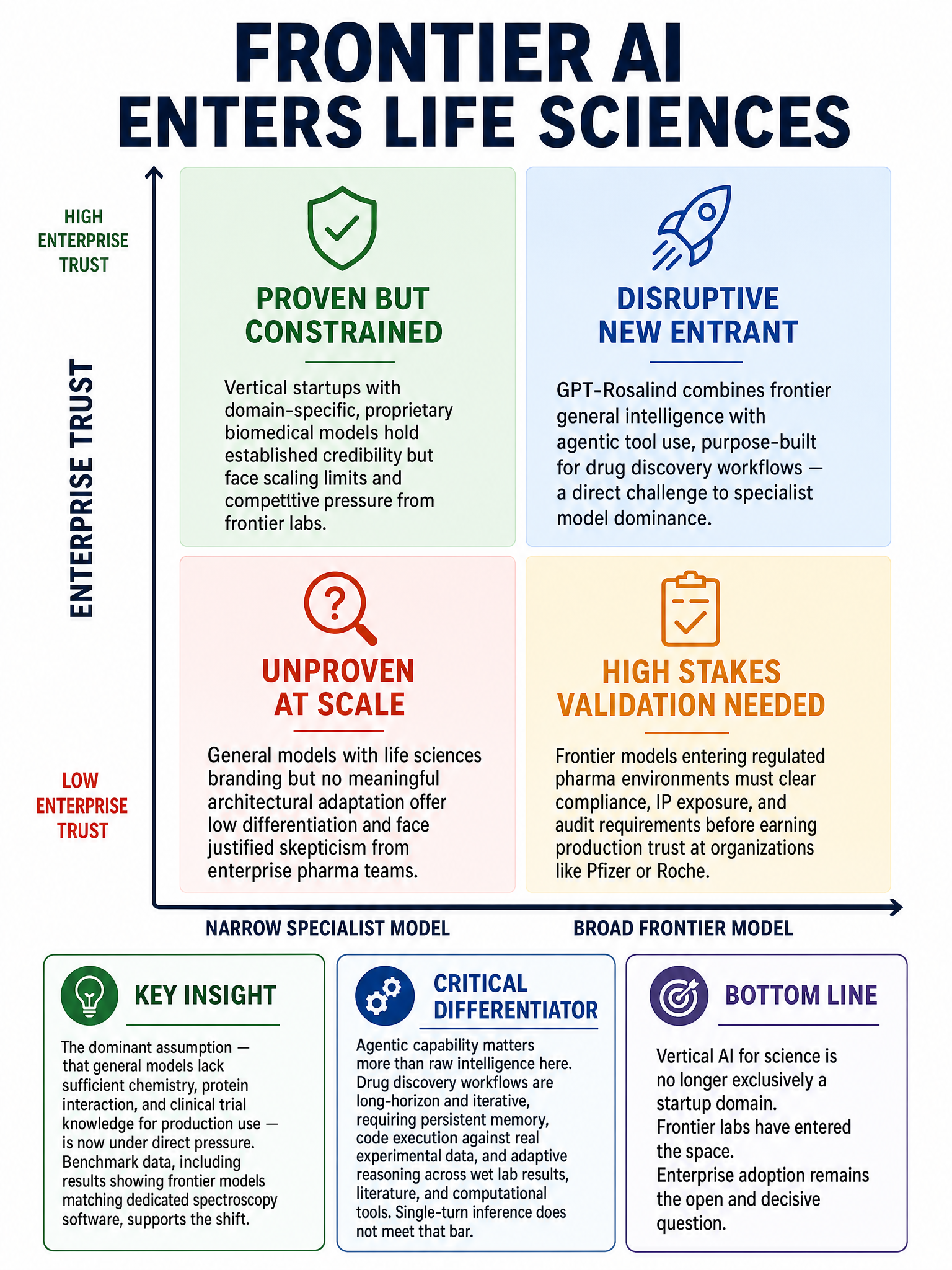
GPT-Rosalind is a model purpose-built for life sciences research at enterprise scale. It combines GPT-5.5’s agentic coding and tool use with reasoning tuned specifically for drug discovery, experimental design, and research workflows. OpenAI’s announcement put it plainly: stronger intelligence for drug discovery, analysis, design, and experimental workflows. This is not a general model with a life sciences sticker on the box.
That distinction matters more than the release itself.
What This Actually Is
The vertical AI-for-drug-discovery space got very crowded very fast. Companies trained smaller, specialized models on curated datasets and sold the pitch that frontier general models were too broad to be trusted with real scientific work.
That argument had legs for a while. GPT-4 really did struggle with nuanced chemistry reasoning. Biology-specific benchmarks showed real gaps. The specialized players had a legitimate value proposition.
GPT-Rosalind is OpenAI’s direct answer. The bet is that frontier-scale general intelligence, when fine-tuned with domain-specific training rather than built from scratch domain-specific, can outperform the narrow specialists. Given what we’ve seen with scale laws over the past three years, I wouldn’t bet against them.
The Competitive Pressure Building Across the Industry
OpenAI is not alone in chasing scientific reasoning as a product category.
Anthropic published results this week showing that Claude Opus 4 matches, and in some tasks beats, dedicated NMR spectroscopy software when analyzing molecular structure. That is a concrete, testable claim against professional domain tools, not just benchmark performance.
Google DeepMind made its Co-Scientist system available to individual researchers through Gemini for Science. Over the past year, Co-Scientist helped identify new targets for liver fibrosis and uncovered fresh approaches to tackling ALS. Those are not demo outputs. That is production-level scientific utility.
The message from all three labs at once is clear. General frontier models are coming for domain-specific tools. Not eventually. Now.
Why I Think the Specialists Are in Trouble
I have watched the vertical AI-for-science wave closely. A lot of those companies raised significant money on the assumption that OpenAI, Anthropic, and Google would stay in the general lane while the specialists owned biomedical territory.
That assumption is dead.
The specialists still have one real advantage: proprietary datasets and relationships with pharma and biotech partners who have already integrated their tools into existing workflows. Switching costs are real. But if GPT-Rosalind hits the performance bar that OpenAI is implying, those relationships will face pressure at contract renewal time.
One datapoint worth sitting with: Anthropic’s internal data shows Claude is accelerating their own engineering output. Anthropic engineers now ship 8x as much code per quarter as they did compared to 2021 to 2025. If that productivity curve applies to research workflows, the compounding effect on drug discovery pipelines could be significant.
What Still Has to Be Proven
I want to be careful here. OpenAI’s announcement tells us what GPT-Rosalind is built for. It does not tell us how it performs against specific benchmarks, what datasets it was fine-tuned on, or how it handles the failure modes that matter most in drug discovery, things like hallucinating binding affinities or misinterpreting assay results.
Life sciences is a domain where confident wrong answers are worse than no answers. The regulatory and safety stakes are not comparable to a coding assistant getting a function signature wrong.
So I am interested, not convinced. The proof will come from researchers actually using it in production, publishing results, and comparing outputs against both domain-specific competitors and their own expert judgment.
The fact that OpenAI named this after Rosalind Franklin is either a thoughtful tribute to one of history’s most consequential and underrecognized scientists, or a very calculated piece of brand positioning. Probably both.
The real test is whether the model is worthy of the name.
Sources
#AI #DrugDiscovery #LifeSciences #OpenAI #GPTRosalind #MachineLearning #Biotech